1. A Lyric Cocktail.
A day devoted to lyrics—short pieces of verse having something of the quality of music, or song texts written specifically
for music. Since most of the remaining classes deal with love songs in various dramatic contexts, such as plays,
musicals, opera, and ballet, the examples today are mainly standalone pieces for one speaker or singer. While most are about
love relationships, none involve direct interaction with the partner; in this respect, they are an exception to the pieces in
the other classes, which mostly do.
We’ll start, however, with another group of exceptions: lyrical pieces that might have figured in the course syllabus, but for
whatever reason don’t fit—outliers, in other words. While these have little bearing on the remainder of the course, they
should make for an involving discussion as a prologue to narrowing down our focus for the rest.
The "texts" link above gives all the lyrics in the order we shall hear them in the session. They will all appear again, as slides
or subtitles, but given the text-oriented nature of this class, you may want to look them over in advance.
The script, videos, and images will be posted immediately after class.
Q AND A
Can you tell us more about the "Fifth Beatle"?
I used the term rather glibly to decribe the role of the Beatles' producer/arranger George Martin. The longer version of the video
I showed is here. Looking at Wikipedia, however, I see that the term has been used a lot
more widely than that. Here is the second paragraph of the Wikipedia article: "The band's members have offered their own views as
to who should be described with the title. McCartney said in a 1997 interview that "if anyone was the fifth Beatle", it was manager
Brian Epstein, and later applied the honorific to producer George Martin in a 2016 memorial post.[2] Harrison said at the Beatles'
1988 induction into the Rock and Roll Hall of Fame that there were only two "fifth Beatles": Derek Taylor, the Beatles' public
relations manager, and Neil Aspinall, their road manager-turned-business-executive.[3] Others referred to as the "fifth Beatle"
include their early drummer, Pete Best, original bassist Stuart Sutcliffe, and keyboardist Billy Preston."
Some further thoughts: love songs and age
It came over very strongly to me today
how much the pleasure of thinking about love songs has to do with the perspective of age. In apologizing for my lack of familiarity
with popular music, I was thinking of myself as an old fuddy-duddy addressing a group who were likely to be much more with it. But today’s
class reminded me that I was in a group of people who were more or less my contemporaries, with very much the
same sense of time. And two things more: (1) that the time perspective is very much a part of how we hear love songs now, and (2) that
to a certain extent lost time can be made up.
I mentioned that the act of playing the Brahms songs from a score my mother must have had in her teens is one kind of communication in time,
taking me back to a period before I was even born. But there are personal memories too. Each of the four songs first spoke to me at a
different stage of my life, from the time when I was first aware of girls as distant wonders, to where I was finally married with a child
of our own—a span (in my case) of a quarter-century at least. I wish more people had commented in class, but one common thread was the
way you related each work to a phase in your past life, anchored by specifics maybe, but still something that in general we could all
share.
The second point probably has to do with the reason we take these Osher courses, or teach them. We are of a certain age, and in
many fields our knowledge stops far short of the present. For me, at least, I find that the process of preparing these classes erases lapsed
time. I mentioned my new-found interest in music videos as an art form, and a very worthwhile one; I would not have had it without the
Osher stimulus. I knew, course, the two Beatles songs and the poems by Donne and Cummings, but I did not at all know the verses by Gizzi
or Olds, or the songs by the Beach Boys or The Magnetic Fields. Discovering them belatedly now, I feel immensely richer. And younger.
Technical issues
Apologies again for letting the mechanics show in my class today. I used to be much smoother in my use of Zoom, and hope to get
that way again. But it is three years since I used the medium, and I have forgotten more than I thought. I will use this two-week
break to catch up. I was heartened, though, by the responses I got despite everything. Thank you! rb.
VIDEO LINKS
All clips shown in class are available in their original YouTube form, often longer than I showed, but mostly without texts, graphics,
or special effects. There is also the moving response of Graham Nash to Joni Mitchell's much earlier song about their break-up, and
three more variations on the Book of Love theme. I especially recommend the documentaries on the Beatles' songs "Yesterday"
and (lower down) "All you need is love," as a reminder that even the most natural song can be the product of much hard work and, in
the case of George Martin, a musically-astute producer whose decisions can give the song its unique flavor.
Not being at home in the field of rock, I trolled through various lists of "The Greatest Love Songs" and listened to many more than I
ultimately showed. I include a selection of these at the end, listed by whether they would fit my "Love" or "Loss" category, and
chronologically within this. Those (most of you, perhaps) who knew these as the soundtrack of your youth may well say "Duh!", but a
few people may find my search interesting. Items that we did not see in class are *asterisked.
| OUTLIERS |
| |
Porter: Anything Goes |
|
* I get a kick out of you, in the show
(Sutton Foster)
* I get a kick out of you, as a duet
(Lady Gaga, Tony Bennett)
|
| |
Donne: "Batter my heart" |
|
* Reading
(Edmund Matyajaszek)
* Setting by Benjamin Britten
(Ian Bostridge)
|
| |
Fritz Kreisler |
|
* Liebesleid
(Anne Akiko Meyers)
* Liebesfreud
(Anne Akiko Meyers)
|
| |
Puccini: Gianni Schicchi |
|
* O mio babbino caro, in concert
(Sissel Kyrkjebø)
* O mio babbino caro, onstage
(Kristina Mkhitaryan)
|
| POETICS |
| |
Billy Collins: Aimless Love |
|
* Live poetry reading
|
| |
EE Cummings |
|
* Love is more thicker than forget
(Sasha Volokh)
* I carry your heart with me
(Helena Bonham-Carter)
|
| FOUR BY BRAHMS |
| |
Brahms Lieder |
|
* Sonntag
(Dietrich Fischer-Dieskau, audio)
* Wir wandelten, wir Zwei zusammen
(as above)
* Minnelied
(as above)
* Wiegenlied
(as above)
|
| LOVE AND LOSS |
| |
Beatles |
|
* Here, There, and Everywhere
* Yesterday
* George Martin on Yesterday & Eleanor Rigby
|
| |
Beach Boys |
|
* God Only Knows
(2022 video)
|
| |
Joni Mitchell |
|
* A Case of You
* — Graham Nash cover
(LoC Mitchell tribute, 2023)
|
| THE BOOK OF LOVE |
| |
Theme |
|
* Stephin Merritt
(original songwriter)
|
| |
Variations |
|
* The Dutch Tenors
* video with still images
(Peter Gabriel version)
* in Shall We Dance?
(Peter Gabriel version)
* — as above, with dialogue
* in Scrubs
* fan-made video
* Gavin James video
|
| POSITIVE VIEWS OF LOVE (NOT SHOWN) |
| |
Elvis Presley |
|
* Can't help falling in love
(what a glorious voice!)
|
| |
Beatles |
|
* She loves you, yeah, yeah, yeah
* All you need is love
(from Magical Mystery Tour, 1967)
* — the making of the above
|
| |
Leonard Cohen |
|
* Hallelujah
|
| |
Whitney Houston |
|
* I will always love you
(from The Bodyguard, 1992)
|
| |
Beyoncé |
|
* Love on top
|
| |
Train |
|
* Marry Me
(marvelous real-life introductions!)
|
| QUESTIONABLE VIEWS OF LOVE (NOT SHOWN) |
| |
Janis Joplin |
|
* Ball and Chain
(Live in Monterey, 1967)
|
| |
Fleetwood Mac |
|
* You can go your own way
|
| |
Phil Collins |
|
* Separate Lives
(from White Nights, 1985)
|
| |
James Morrison |
|
* Broken Strings
|
| |
Jack White |
|
* Love Interruption
|
| |
|
|
|
|
|
| IMAGES |
The thumbnails below cover the slides shown in class, though
there may be a few small discrepancies.
Click the thumbnail to see a larger image.
Click on the right
or left of the larger picture to go forward or back, or outside it to close. |
 | |
 | |
 | |
 | |
 | |
 | |
 | |
 | |
 | |
 | |
 | |
 | |
 | |
 | |
 | |
Here are brief bios of the composers and writers considered in the class (plus in this instance a few performers), listed in
order of birth.
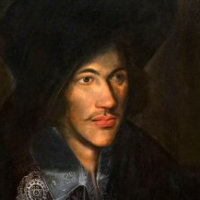 |
John Donne, 1572–1631. English poet and cleric.
Though classed with the Metaphysical Poets of the early 17th century, he had an immense range, from erotic to sacred, characterized by an extraordinary intensity. He took holy orders later in life, and was appointed Dean of St Paul's Cathedral.
|
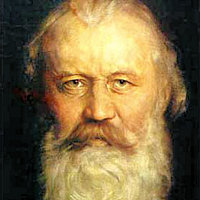 |
Johannes Brahms, 1833–97. German composer.
Although writing music whose harmonies and colors eiptomized the Romantic age, Brahms was a classicist at heart, developing the traditional forms of symphony, sonata, quartet and so on, and avoiding program music and opera. A master of virtually every genre, he is often listed together with Bach and Beethoven as the third of the "Great Bs."
|
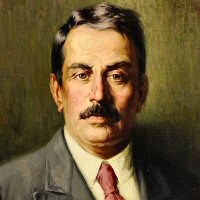 |
Giacomo Puccini, 1858–1924. Italian composer.
Puccini took up the mantle of Verdi as the dominant opera composer of the late 19th century, and developed an international popularity that is unrivaled to this day. His principal works include: Manon Lescaut (1893), La bohème (1896), Tosca (1900), Madama Butterfly (1904), and the unfinished Turandot (1926).
|
 |
Fritz Kreisler, 1875–1962. Austrian-American composer and violinist.
Before he was even in his teens, Kreisler studied at both the Vienna and Paris Conservatories, winning the top prize at the latter when he was only 12. For a while, though, he gave up the violin to study medicine. He returned to music in 1899, soon triumphing in Berlin and touring America, where he met his wife, remaining with her until his death. Although the couple lived in Europe between the Wars, Kreisler returned to America in 1939 and became a citizen in 1943. A composer himself, he also commissioned the Elgar Violin Concerto in 1910.
|
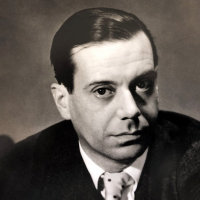 |
Cole Porter, 1891–1964. American songwriter.
Unlike many Broadway composers, Porter wrote not only the music but the lyrics for his songs, and these are notable for their wit, clever rhyming, and encyclopedic range of reference. In addition to numerous standalone songs that became standards, he also wrote musicals such as Anything Goes (1934), Kiss Me, Kate (1948), and Can-Can (1953).
|
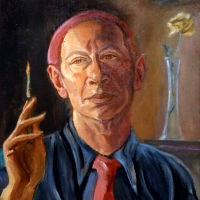 |
E. E. [Edward Estlin] Cummings, 1894–1962. American poet and painter.
In addition to several thousand poems, Cummings also wrote four plays and two novels; he painted his own portrait in the National Portrait Gallery. A leading modernist, he was known for radical experiments in orthography and punctuation, frequently including the elimination of upper-case letters, but he deprecated the use of this style for his own name.
|
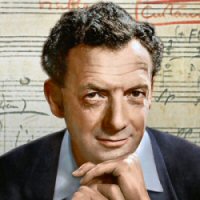 |
Benjamin Britten, 1913–76. English composer.
Arguably the leading opera composer of the mid-20th century, Britten's major operas have included Peter Grimes (1945), Billy Budd (1951), Gloriana (1953), A Midsummer Night's Dream (1960), and Death in Venice (1973), plus many stage works for smaller forces. He was equally active as a composer of instrumental music and text settings, and latterly as a conductor and accompanist.
|
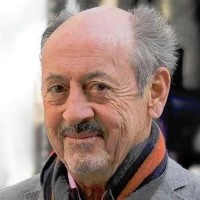 |
Billy Collins, 1941– . American poet.
One of the best-known and most approachable contemporary American poets, Collins was Poet Laureate of the United States
between 2001 and 2003.
|
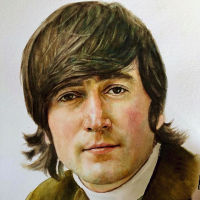 |
Paul McCartney, 1942– . British composer, lyricist, and singer.
Sir Paul McCartney gained global fame with the Beatles, playing as their bassist, and sharing the lead singing with John Lennon. With Lennon, he wrote both words and music for most of the Beatles' song, one of the most successful partnerships in history. His eclectic interest in other styles and technical innovation was largely responsible for the evolution of the group's studio recordings. He continued this exploration later with his own band, Wings, and in a range of compositions that even overlap with classical music.
|
 |
Sharon Olds, 1942– . American poet.
Born in California in a strict Calvinist household with a controlling father, Olds spent much of her youth finding ways to rebel against that background. She won the 1984 National Book Critics Circle Award and 2013 Pulitzer Prize for Poetry, and at least until recently was teaching at NYU.
|
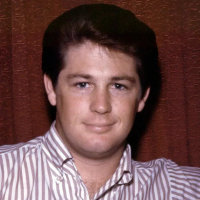 |
Brian Wilson, 1942–2025. American composer and singer.
Largely self-taught, Brian Wilson co-founded The Beach Boys in 1961, with his brothers and two cousins. He soon emerged as their creative force, writing and producing most of the group's material, the first rock musician to do so exclusively. He is also the first credited with using studio effects as an addtional "instrument."
|
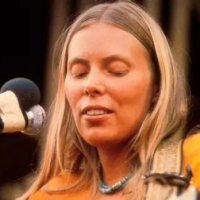 |
Joni Mitchell, 1943– . Canadian singer-songwriter.
Emerging from the folk music scene of the 1960s, Mitchell moved to California and made a name for her very personal lyrics and a musical style that gradually expanded to include elements of rock and jazz. She has won 11 Grammy Awards and numerous other accolades. Her 1971 album Blue has aften been cited as a turning-point in American popular music.
|
 |
Peter Gabriel, 1950– . British singer-songwriter and activist.
Gabriel came to prominence as the original frontman of the British band Genesis. He left the group in 1975 to pursue a solo career, achieving platinum status with his album So in 1986. That same year, he began a lifelong partnership with Amnesty International, appearing in or highlighting every one of their Human Rights concerts.
|
 |
Peter Gizzi, 1959– . American poet.
Born in Michigan to Italian-American parents, Gizzi has carved a path for himself as a poet. After high school, he worked for a while in a treatment center for emotionally-disturbed adolescents, while publishing a niche journal for poetry by himself and others. He has taught at Brown, the Universities of California and Massachussetts, and Cambridge (England).
|
 |
Stephin Merritt, 1965– . American singer-songwriter.
Merritt was the founder and leading songwriter of the indie band The Magnetic Fields. He has an intellectual interest in writing songs that pursue a technical challenge rather than emotional confession. One example is the three-album collection 69 Love Songs (1999), almost none of which are conventional romantic ballads—though one of them, The Book of Love, has inspired numerous cover versions and is a favorite for weddings.
|


