1. A Bunch of Brits.
This class asks two major questions, and uses a group of British artists to do it. What do we mean by Popularity? And what
can happen in the later career of an artist who achieves it? Christopher Marlowe was a great playwright; he just had the
misfortune to be the exact contemporary of an even greater one, and to get himself killed at 29, before he could compete
with Shakespeare head on.
The other five artists all belong to the Long Nineteenth Century, the first period in which the concept of mass popularity
had any real meaning. Two poets, two composers, and a painter: all were famous in their time, or at least notorious, but all
are much less well-known now than they were then. Why? The reasons are different in each case. rb.
The script, videos, and images will be posted immediately after class.
Here are brief bios of the composers and writers considered in the class, listed in order of birth.
 |
Christopher (Kit) Marlowe, 1564–93. English dramatist and poet.
With plays such as Edward II and Doctor Faustus, he was the preeminent tragedian in England until he was murdered at the age of 29, when his crown passed to Shakespeare.
|
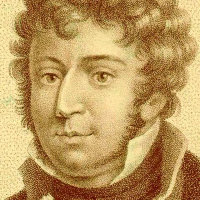 |
John Field, 1782–1837. Irish composer.
Born in Dublin, he made his début in London at age 9, and then came under the wing of Muzio Clementi, less as a pupil than an agent for his pianos, going with him all around Europe. He settled in St. Petersburg in 1803, where he spent the rest of his career. He is credited with inventing the piano Nocturne and thus influencing the music of Chopin and others.
|
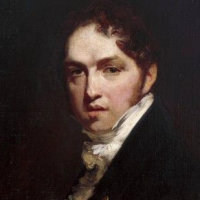 |
George Robert Lewis, 1782–1871. English painter.
Lewis worked in a variety of genres, but he is best known for his naturalistic lanscapes and closely-observed studies of country people.
|
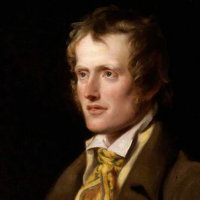 |
John Clare, 1793–1864. English poet.
The son of an agricultural laborer, Clare worked the land himself. Leaving school at age 12, he nonethless continued to read as much as he could and write about his experience of rural life. His first book of poems found their way to Keats' publisher; their publication in 1820 with a further volume in 1821 made him instantly famous, but he passed through alcoholism into madness and ended his life in a mental hospital.
|
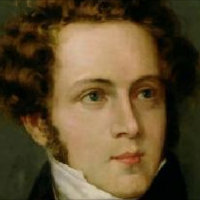 |
Vincenzo Bellini, 1801–35. Italian composer.
The short-lived Bellini, who was born in Sicily, trained in Naples, and finally achieved success in Milan and Paris, with his operas La sonnambula, Norma, and I puritani. Renowned for his long melodic lines and psychological acumen, he was the quintessential composer of bel canto opera.
|
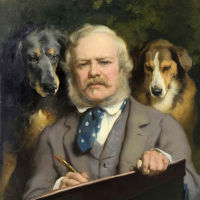 |
Sir Edwin Landseer, 1802–73. English artist.
He is best known for his numerous animal paintings, such as the once world-famous Monarch of the Glen, and for his scuptures of lions around Nelson's Column in London's Trafalgar Square.
|
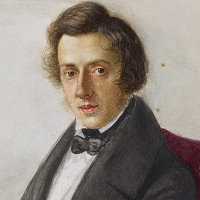 |
Fryderyk Chopin, 1810–49. Polish composer.
Chopin was a virtuoso pianist (though for the most part avoiding the concert stage), and wrote almost exclusively for the piano, in a variety of shorter forms, many reflecting the dances of his native Poland, which he left at age 20 to escape the consequences of a revolution. He spent his adult life in Paris, where he was a frequent guest at salons. He maintained a long relationship with the writer George Sand.
|
 |
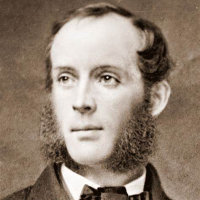
William McGonagall, 1825–1902. Scottish thespian and poet.
McGonagall, who may actually have been born in Ireland, was a mill-worker and amateur actor when in 1877 he suddenly had the conviction that he was destined to be a poet. From then on, he wrote numerous narrative ballads and toured the country reciting them. He was oblivious to the opinion of others, and indeed to most poetic conventions other than rhyme. But his fame did not last; he died in poverty.
|
 |
Frederic Edwin Church, 1826–1900. American painter.
A pupil of Thomas Cole, Church was (with Bierstadt) the outstanding landscapist of the second generation of the Hudson River School. He was attracted to highly dramatic subjects, such as his Niagara, which made him famous, and traveled to the Andes and Middle East in search of them.
|
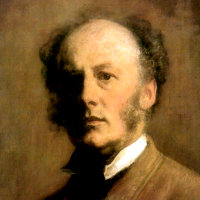 |
John Everett Millais, 1829–96. English painter.
Millais was, with DG Rossetti and William Holman Hunt, one of the founders of the Pre-Raphaelite Brotherhood in 1848. At first noted for his highly realistic treatment of religious and literary subjects, he later adopted a more sentimental style, with which he was hugely successful.
|
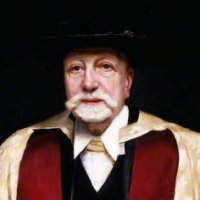 |
Alexander Campbell Mackenzie, 1847–1935. Scottish composer.
A violinist, Mackenzie trained in Germany and began his career in orchestras there. He later enrolled at the Royal Academy of Music in London—he would eventually become its Principal—and began composing while continuing to play the violin as a living. Many of his works have a Scottish theme, including three Scottish Rhapsodies (1880, 1881, and 1911) for orchestra.
|
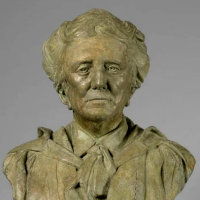 |
Ethel Smyth, 1858–1944. English composer.
Dame Ethel Smyth was known as much for her political and feminist activism as for her music, which was strongly influenced by her training and early career in Germany. Her best-known opera, The Wreckers (1906) contains some excellent music.
|


