2. Restoration.
When composers die, the situation they leave behind differs from that of other artists. Writers leave their books; painters
leave their canvases; but before the age of recording, continued familiarity with a composer’s work required the availability
of scores and musicians with the skills to perform them. Most of the figures in this class were widely popular in their day,
but until restored by the Early Music movement of the past few decades, all had lapsed into relative obscurity, at least for
their music.
There are two partial exceptions. Johann Pachelbel was respected in his time, though not popular in the modern sense—but the
viral spread of one 1968 recording made him into a baroque superstar. And though Handel continued to be well-known for his
Messiah and Water Music, his operas—the main source of his fame in his lifetime—have required significant
shifts in approach over the past half-century to restore them to the repertoire status they deserve. rb.
The script, videos, and images will be posted immediately after class.
VIDEO LINKS
All the clips shown in class are available on YouTube at the links below, often at greater length. I added the full versions
of the Dufay and Josquin chansons, and another beautiful Cavalli finale (Erismena) that I didn't have time to
show. For Calisto, I added three complete performances, including an archival one of the premiere of Leppard's version
at Glyndebourne. You will also find the very powerful extended scene when Juno comes down to investigate her husband's
infidelity, and the trailer of the 2020 production at La Scala, an unusually large house for such repertoire. I would also
have loved to have been able to obtain a video of last year's production at Aix, shown above, which shifts the action out of
Greek myth and a century forward from Cavalli into a Liaisons Dangereuses world. rb.
| A. MEDIEVAL POLYMATH |
| |
Hildegard von Bingen |
|
* O frondens virga
(Chanticleer, with Hildegard images)
* Ordo virtutum, first temptation
(The Song Co.)
|
| |
Vision, 2009 film |
|
* Trailer
(film by Margarethe von Trotta)
* Ordo virtutum
* Lament
|
| B. THE ARMED MAN |
| |
Anonymous |
|
* L'homme armé
(Ensemble Madrigal)
|
| |
Dufay |
|
* Donnes l'assault à la fortresse
(my video)
* — full audio of the above
|
| |
Binchois |
|
* Fillles à marier
(Comet Musique)
* Triste plaisir
(Sollazzo Ensemble)
|
| |
Josquin des Prés |
|
* Missa L'homme armé, opening
(Magnum Mysterium Ensemble)
* Scaramella va alla guerra
(my video)
* — live performance of the above
(Le banquet du roy)
|
| C. HIS MUSIC WENT VIRAL |
| |
Pachelbel's Canon |
|
* Jean-François Paillard
(audio)
* Voices of Music
* André Rieu
|
| |
Influence on pop music |
|
* Frank Cotty
(adaptations of the melody)
* David Bennett
(harmonic analysis)
|
| D. WHAT A TOWN! |
| |
Cavalli: Calisto |
|
* Complete opera, 1970
(Glyndebourne premiere, low quality)
* Complete opera, 1996
(Brussels, no titles)
* Complete opera, 2017
(Strasbourg, French titles)
* Calisto's first aria
(Nuria Rial, Arpeggiata)
* Calisto's second aria
(Elizabeth Hetherington, B'Rock)
* Seduction scene
(Strasbourg 2016, French titles)
* Giunone, Calisto, Giove/Diana
(Strasbourg 2016, French titles)
* La Scala 2020, trailer
|
| |
Other Cavalli operas |
|
* Giasone extended trailer
(Antwerp)
* Ercole Amante trailer
(Opéra Comique, Paris)
* Ormindo, final ensemble
(Studio recording)
* Erismena, final ensemble
(Aix-en-Provence)
|
| E. AN IRRATIONAL ENTERTAINMENT |
| |
Handel: Orlando |
|
* Aria, "Fammi combattere"
(Bejun Mehta concert)
* Trio, "Consolati, O bella"
(Zurich 2008)
|
| |
Other Handel operas |
|
* Giulio Cesare,"Fra tempeste"
(Danielle de Niese. Glyndebourne)
* Alcina, "Or s'apre al riso"
(Anna Prohaska, Aix, part only)
|
| |
|
|
|
|
|
| IMAGES |
The thumbnails below cover the slides shown in class, though
there may be a few small discrepancies.
Click the thumbnail to see a larger image.
Click on the right
or left of the larger picture to go forward or back, or outside it to close. |
 | |
 | |
 | |
 | |
 | |
 | |
 | |
 | |
 | |
 | |
 | |
 | |
 | |
 | |
 | |
 | |
 | |
 | |
 | |
 | |
 | |
 | |
 | |
 | |
 | |
 | |
 | |
 | |
 | |
 | |
Here are brief bios of the composers and writers considered in the class, listed in order of birth.
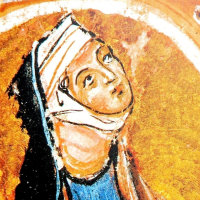 |
Hildegard von Bingen, 1098–1179. German polymath.
Abbess of the monastery of Rupertsberg on the Rhine, and composer of the music drama Ordo Virtutum, she achieved extraordinary fame as a theologian, poet, composer, manuscript illuminator, and natural scientist, becoming known as "The Sibyl of the Rhine." The Catholic Church has long revered her as a saint.
|
 |
Jan van Eyck, 1390–1441. Netherlandish painter.
The most celebrated and influential northern painter in the earlier 15th century, responsible for developing a style of oil painting capable of magnificent detail and effects of light. His major work, the altarpiece in Ghent Cathedral, is recorded to have been begun by his perhaps even greater brother Hubert. He was a renowned portraitist, including the enigmatic Arnolfini Marriage in London, and the supposed self-portrait seen here.
|
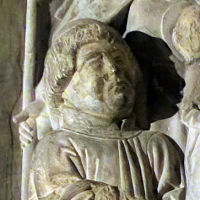 |
Guillaume Dufay, 1397–1474. Franco-Flemish composer.
Dufay (also spelled Du Fay and other variants) was born near Brussels. Writing in most genres and traveling widely, he was regarded as the leading composer of his time, composing for example a motet for the dedication of Brunelleschi's dome of Florence Cathedral. [The portait comes from his tomb.]
|
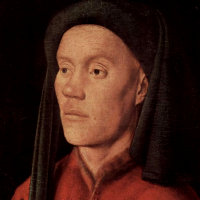 |
Gilles Binchois, 1400–60. Franco-Flemish composer.
Binchois was praised by his contemporaries in the same breath as Dufay, though his fame has declined somewhat. He is especially memorable as a melodist, with a gift for the long expressive line in both his secular and sacred vocal work. [He may or may not be the subject of this portrait by Jan van Eyck.]
|
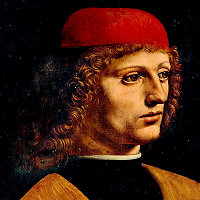 |
Josquin des Prez, 1440–1521. Franco-Flemish composer.
Josquin is considered one of the leading composers in the High Renaissance, and not just in the Franco-Flemish school. Almost all his works are vocal, mostly sacred. He is credited with breaking away from the tradition of long melismatic lines, writing instead in short imitative phrases that are closely expressive of the text. [This portrait of a musician by Leonardo da Vinci has not definitely been identified as Josquin, although both were in Milan at the same time.]
|
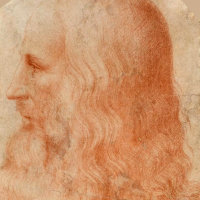 |
Leonardo da Vinci, 1452–1519. Italian painter and polymath.
With Michelangelo and Raphael, one of the triumvirate of artistic geniuses that crown the High Renaissance. He trained in Florence with the painter Andrea Verrocchio before moving to the court of Ludovico Sforza in Milan. He spent the last years of his life at the court of François I in France. The naturalism and luminosity of his painting, and his effects of sfumato (or modeling as if by smoke), were widely influential. It is his notebooks, however, that are the best testament to the range of his genius, containing remarkable observations of the natural world, and mechanical inventions centuries before their time.
|
 |
Pier Francesco Cavalli, 1602–76. Italian composer.
The leading opera composer after Monteverdi, his works dominated the Venetian stage in the mid 1600s, and frequently addressed mythological subjects, such as his La Calisto (1651).
|
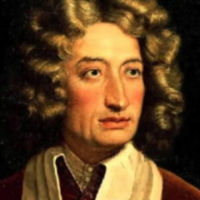 |
Johann Pachelbel, 1653–1706. German composer.
An organist as well as a composer, Pachelbel was influential in setting standards for German sacred music in the era before Bach. His output was prolific, but he is best known today for a secular work, his Canon and Gigue in D for three violins and continuo.
|
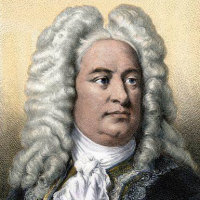 |
George Frideric Handel, 1685–1759. German-born English composer.
Gradually over the last half-century, Handel's 42 operas and numerous dramatic oratorios have been recognized as placing him on the level of Mozart and Verdi as an opera composer. The delay in appreciation is partly due to the fact that his preferred form, opera seria, is based almost entirely on recitative and solo arias. Born in Germany and trained in Italy, he dominated the English musical scene in the first half of the 18th century.
|


