3. Some Brighter Sun.
The first two-thirds of this class will consider composers, painters, or writers who were famous at the end of their
fairly long lives. Whether or not this translated into lasting fame after their deaths, though, another matter entirely.
Some faded from the limelight because taste had moved on, others because some brighter sun appeared in the firmament, and
at least one because it was easier to attribute work of that quality to a famous man than to an unknown woman.
In the last third of the class, we look at the opposite situation. Most Romantic artists (in whatever medium) produced
their best work in their twenties; a few also died at around that age. Is fame in such circumstances necessarily always
posthumous? And does early death always imply unfulfilled promise? Are there not some short-lived figures who nonetheless
managed to squeeze in a full career and leave this world as fully mature artists?
The script, videos, and images will be posted immediately after class.
Q AND A
Why do some artists remain famous while others are forgotten?
This is the question that I started this entire course trying to answer. I'm afraid that today's class may have suggested
several different answers without settling on any. If we are talking more broadly, I think we would have to distinguish
between public recognition and critical recognition. The public values a product that both pleases them and
meets their expectations; they like to recognize an artist's work and to be delighted by it. Public recognition tends to
snowball; after a while, it becomes self-confirming. It is also a matter of taste, and tastes can change. But the public
cannot simply be discounted; one definition of "popularity," the subject of this course, is continuation in public estimation
through most or all of the artist's life. And the most common reason for later oblivion is that tastes changed.
So how is critical estimation different?
By critical estimation, I mean the ranking of fellow professionals, or those whose job it is to think about art in a
more analytical way. As a stage director, I know the difference between a work that gives me something new each time I come
back to it, as opposed to one that doesn't; the same must be true of other branches of the arts. Call it the surprise
factor. Mozart and Beethoven (and Wagner and Verdi) have always had that ability; Salieri, I suspect, doesn't. The surprise
factor may not be necessary for popularity in one's time; it may even count against it. But that quality of inexhaustibility
is surely a strong component of posthumous reputation.
Why do some artists stop producing?
There will be more to come on this in later classes. Most artists simply keep working for as long as they can, but many
(perhaps most) will have long since ceased to produce work that is truly new. Is this why Rossini stopped? I doubt it; there
is enough new in William Tell as to presage a new career, had he wanted to develop it. So perhaps he was simply
rich enough, and tired.
What about the posthumous reputation of artists who died young?
In retrospect, I am not sure that the final section really belonged in today's class. I do know there were too many names
in it; I should have stuck to Byron, Géricault, and Schubert. I think it ties in with this ability to keep surprising. Is
there a difference between a poet like Keats, who did wonderful things while young but then died, and another like Wordsworth,
who was also wonderful when young but lived long beyond that first creative span? But if the ability to intrigue has a great
deal to do with lasting fame, then the possibility of musing on that if-only factor is certainly intriguing. To be continued.
VIDEO LINKS
All the videos shown in class are available on YouTube. This does not include the title videos I made myself, but
I do give links to the music used in them. For these and all other music played in class, I have given the complete
work wherever possible, but cued the link to the point we started in class. I also added three video discussions about
Judith Leyster, a couple more clips from Amadeus, and some fun things about the Mozart/Salieri relationship
generally; these are all *asterisked. In the end, I did not follow through on my idea of
adding other composers of Hummel's generation. Still, there is a lot more out there on just about every topic mentioned.
rb.
| |
|
|
|
|
|
| IMAGES |
The thumbnails below cover the slides shown in class, though
there may be a few small discrepancies.
Click the thumbnail to see a larger image.
Click on the right
or left of the larger picture to go forward or back, or outside it to close. |
 | |
 | |
 | |
 | |
 | |
 | |
 | |
 | |
 | |
 | |
 | |
 | |
 | |
 | |
 | |
 | |
 | |
 | |
 | |
 | |
 | |
 | |
 | |
 | |
 | |
 | |
 | |
 | |
 | |
 | |
 | |
 | |
 | |
 | |
 | |
 | |
Here are brief bios of the composers and writers considered in the class, listed in order of birth.
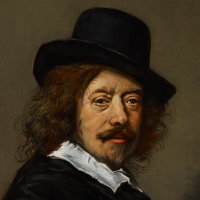 |
Frans Hals, 1582–1666. Dutch painter.
Though born in Antwerp, he moved to Harlem with his parents and spent the rest of his life there. 24 years older than Rembrandt, he was the first great master of the Dutch Golden Age and its leading portraitist. His style is remarkable for the effects he could achieve from a few swift touches of paint.
|
 |
Judith Leyster, 1609–60. Dutch painter.
Born in Haarlem, she probably studied with Frans Hals, and her work was later frequently sold as his. She was, however, a Guild-certified Master in her own right, with several appentices, and maintained good sales in the genre subjects that were her main specialty.
|
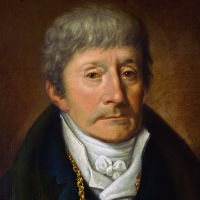 |
Antonio Salieri, 1750–1825. Italian composer.
Though famous in legend as Mozart's nemesis in Vienna, Salieri was the more successful composer in his day, writing over twice as many operas, including Europa riconosciuta, about the later life of Ovid's heroine, which inaugurated the La Scala opera house in 1778. He also wrote operas in French for Paris, and a couple of comic operas for performance back home, plus an enormous amount of sacred music. He taught Beethoven, Schubert, Liszt, and Mozart's son.
|
 |
Thomas Chatterton, 1752–70. English poet.
Chatterton began writing poetry while still a child, and published some of it in Liverpool before moving to London. where he attracted a couple of infliential patrons. But his work, purporting to be the rediscovered writings of a medieval monk, and written in a fake old-English, also incurred criticism, and he poisoned himself shortly before his 18th birthday. Wordsworth, Coleridge, and Keats, however, saw him as the prototypical Romantic poet, and a martyr to the muse. [The image, by Henry Wallis, imagines him after his suicide.]
|
 |
Wolfgang Amadeus Mozart, 1756–91. Austrian composer.
A child prodigy as both performer and composer, Mozart produced an extraordinary body of work in all genres over a relatively short life. He wrote the greatest of his many operas after moving to Vienna: three collaborations with Lorenzo da Ponte—The Marriage of Figaro (1786), Don Giovanni (1787), and Così fan tutte (1790)—framed by two German Singspiels: The Abduction from the Seraglio (1782) and The Magic Flute (1791).
|
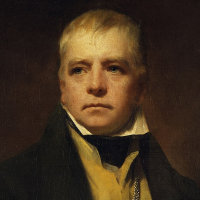 |
Sir Walter Scott, 1771–1832. Scottish poet and novelist.
Scott's historical novels, all set in his native Scotland, spoke to the Romantic spirit and were immensely popular throughout Europe, inspiring many adaptations such as Rossini's Donna del lago and Donizetti's Lucia di Lammermoor.
|
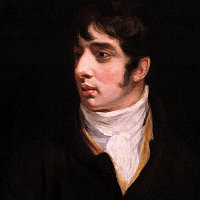 |
Thomas Girtin, 1775–1802. English watercolorist.
Hailed as the father of English watercolor, his landscapes freed the medium from its origins in tinted drawings, painting directly in transparent washes on white paper. Turner, an early work companion, later said "Had Tom Girtin lived, I should have starved."
|
 |
Johann Nepomunk Hummel, 1778–1837. Austrian composer.
A pupil of Mozart and Salieri and a friend of Beethoven, Hummel's career as composer and performer spanned their combined lived. With prestigious appointments in Vienna, Stuttgart, Weimar, and London, and numerous compositions to his name, Hummel was the paradigm of the early 18th-century composer, and died a famous man, only to be forgotten by later generations.
|
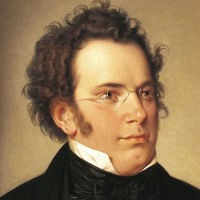 |
Franz Schubert, 1787–1828. Austrian composer.
Although he died before his 32nd birthday, Schubert was extremely prolific as a composer, writing symphonies, masses, chamber music, piano sonatas, and over 600 songs, both individually and in cycles. Though little known in his lifetime outside his immediate circle, his work was rediscovered and championed by Mendelssohn, Liszt, and Brahms, making him in effect the source of the German Romantic movement.
|
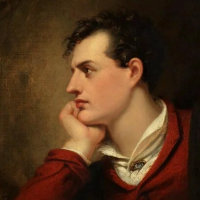 |
George Gordon, Lord Byron, 1788–1824. English poet.
Byron, an hereditary peer, was one of the leading poets of the Romantic age, and the one whose passions and unconventional lifestyle most clearly defined the Romantic Hero, especially among his admirers in France, Germany, and Russia. His long poems Don Juan and Childe Harold's Pilgrimage are epic in scope and show his characteristic combination of action and wit. He died in Greece at the age of 36, fighting in the Greek War of Independence.
|
 |
Théodore Géricault, 1791–1824. French painter.
Géricault's monumental Raft of the Medusa (1819) was a seminal work in French art, treating a contemporary political scandal with searing humanity coupled with a monumentality that owes much to Michelangelo. His many studies for this work, including corpses and severed limbs, his portraits of the insane, and above all his numerous paintings of horses, made him a key figure in French Romanticism until his death from a riding accident at the age of 32.
|
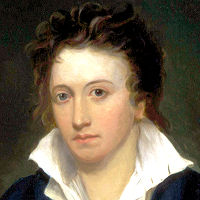 |
Percy Bysshe Shelley, 1792–1822. English poet.
With his friend Byron, Shelley was the outstanding English Romantic poet of the generation after Wordsworth and Coleridge. Politically engaged, and intellectually acute, he was an avowed atheist, a stance that got him expelled from Oxford, and kept him out of England for much of his short career. He drowned in a boating accident off Livorno at the age of 29. His second wife, Mary Godwin Shelley, was the author of Frankenstein.
|
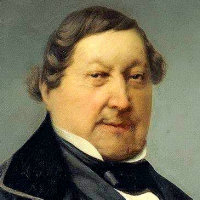 |
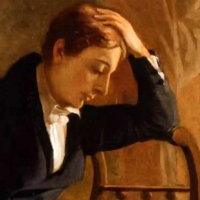
Gioacchino Rossini, 1792–1868. Italian composer.
Rossini's fame rests on his 39 operas, especially the comedies, all written while he was still in his thirties. In 1829, fter writing Guillaume Tell, one of the foundation stones of French grand opéra, he essentially retired, settling in Paris, and writing only occasional pieces plus his masterpieces of sacred music, the Stabat Mater of 1842 and Petite Messe solennelle of 1864.
|
 |
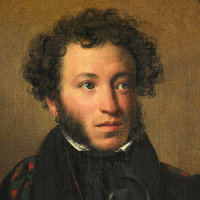
John Keats, 1795–1821. English poet.
Keats was a second-generation Romantic, contemporary with Byron and Shelley. By the time he died of tuberculosis at the age of 25, he had been publishing for less than four years. Nevertheless, later critics have hailed him as one of the greatest English poets, especially for his Sonnets and series of Odes.
|
 |
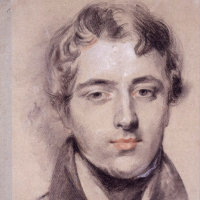
Alexander Pushkin, 1799–1837. Russian poet.
While in exile because of verses critical of the Tsar he wrote his most celebrated play Boris Godunov. His masterpiece is the novel in verse Eugene Onegin, serialized between 1825 and 1832. While his range is extraordinary and an inspiration to later Russian composers, he is celebrated as much for restoring the Russian language (as opposed to French) as the vehicle for artistic expression.
|
 |
Richard Parkes Bonington, 1802–28. English painter.
Although born in England, Bonington moved to France with his parents in his teens, studied with Gros, and became friends with Delacroix. Although he also worked in oil, his best work may be in watercolor, which he handled with a freshness of touch that Delacroix found unique.
|
 |
Juan Crisóstomo Arriaga, 1806–26. Basque composer.
Arriaga is often called "the Spanish Mozart," because of his facility, because of his short life and because he wrote in a vein that owed much to the earlier composer. Unfotunately, he died before he was able to develop the individual style that can just be glimpsed in his extant works.
|
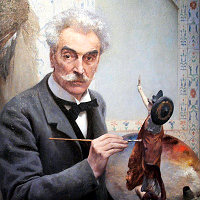 |
Jean-Léon Gérôme, 1824–1904. French painter.
A leading academic painter of the mid-century, his works have been described by one critic (Lorenz Eitner) as "carefully plotted picture-plays, graced with sex, spiced with gore, and polished into waxwork lifelikeness by a technique that his admirers took for realism." He was much favored by American buyers including William Walters for his collection in Baltimore.
|
 |
Henry Wallis, 1830–1916. English painter.
Finding early success with The Death of Chatterton in 1856, he continued to paint oils in the Pre-Raphaelite vein. In later life, he became increasingly interested in watercolor painting.
|
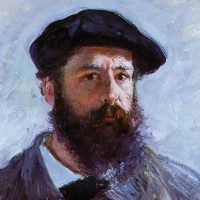 |
Claude Monet, 1840–1926. French painter.
The central figure in Impressionism (it was his Impression: Sunrise of 1872 that gave the movement its name), he intensified its focus more than any other artist, continuing well into the next century to produce series of paintings showing minute variations in the light and color in basically the same scene. Cézanne famously said of him, "Monet is nothing but an eye—but my God, what an eye!"
|
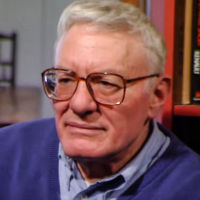 |
Peter Shaffer, 1926–2016. English playwright.
Sir Peter Shaffer's plays have been associated with the English National Theatre since its founding; they include The Royal Hunt of the Sun (1964), Black Comedy (1965), Equus (1973), and Amadeus (1979). He was the twin bother of mystery playwright Antony Shaffer, author of Sleuth (1970).
|


