4. The Epic Quest.
The class begins with an 18th-century Scottish poet, James Macpherson, who attained immense popularity with his
epic translations of the Gaelic bard Ossian. Goethe made his own versions; Jefferson and Napoleon both considered
Ossian one of the greatest poets of all time. Yet when it eventually became clear that the so-called translations were
all Macpherson's own work, he returned to obscurity.
Few stories of fleeting popularity are this dramatic. But although many later writers have been tempted into writing
epics, particularily to fuel the fires of Romantic Nationalism, they have done so at their peril. it is more common
these days for Romantic poets to be appreciated despite their epics than because of them. But the epic
spirit has survived in numerous derived works in verse or music and in the visual arts. And in our lifetime, the
epic mode has been given a boost by the works of JRR Tolkien or JK Rowling and films in a similar vein, creating
a new genre of blockbuster fantasy for a new generation.
The script, videos, and images will be posted immediately after class.
Q AND A
How old is the legend of Dozmary Pool?
Mark wondered if the association of Dozmary Pool with SIr Bedivere and Excalibur dates back to the middle ages, or if
it is a more recent attribution. The best I can find out is that it is an "old legend." There are several videos and
articles that don't say very much. The fullest and best-argued among them is
this,
but its bottom line is that there is probably no truth to any of the legends it discusses. It does not reallly explore the
question of when the legend started, though. Sorry.
Is there anything significant you had to leave out?
I worry that these classes may be too light on material, so often end up putting in more than I really have time for, as I did
today; sorry about that. The things that I didn't get to show in the list below are the Sibelius Swan of Tuonela (a
lovely haunting piece; do listen if you don't know it), the second Alice Oswald reading, the segment on Derek Walcott, and
the Star Wars and Skyrim trailers, which are interesting in showing that the taste for epic has emigrated
to Hollywood, lock, stock, and barrel! You may find any or all of the additional Ossian material interesting.
VIDEO LINKS
Everything in available, though not necessarily in the form seen in class. The main problems are the two operas in the second
hour. The Monteverdi production is available complete, though without titles; I also included the very moving final scene. The
London production of Les Troyens resurfaced in San Francisco, and I have ten minutes' worth of highlights from that. For
the love duet, I have shorter versions with different singers, one a rather mannered stage production, the other in concert,
but both beautiful.
There are several additions: a bunch of things relating to Ossian, including a useful article and part of an Ossian opera; a
highlight reel of Camelot; the trailer for a stage production (yes!) of Alice Oswald's Memorial; two longer
discussions of Omeros; and, to be fair, a reading of Longfellow's Hiawatha that does not make him so ripe for
parody. The numerous videos of Wagner's Ring operas would have been too many for me to list, and the same situation
applies to the Lord of the Rings and Star Wars movie franchises. I confess to picking the Skyrim trailer
more or less at random, just to include an epic video game, but there is much more out there.
*Asterisks indicate items not shown in class. rb.
| INTRODUCTION |
| |
Section titles |
|
* All animated titles made for the class
|
| |
Macpherson's Ossian |
|
* Incantation
(original version of my opening video)
* Six Bards
(audio of video used in class)
|
| |
More on Ossian |
|
* The Scottish Book that Changed the World
* Article about the Ossian bubble
(much useful information)
* Le Sueur: Ossian, ou les bardes,
(Napoleonic opera!)
* Wordsworth: Glen Almain
(at supposed Ossian grave site)
* Gade: Echoes of Ossian
(Gade's Op.1; used under 6 Bards video)
|
| MEDIEVAL MYSTIQUE |
| |
Tennyson: Idylls of the King |
|
* BBC dramatization
(cued to start in class)
|
| |
Lerner & Loewe: Camelot |
|
* Final Scene
* Compilation of excerpts
(10 minutes of highlights)
|
| |
Wagner's Ring |
|
* Siegfried, end of Act II
(Bayreuth 1977, complete with titles)
|
| FROM FINNISH FORESTS |
| |
Lönnrot: Kalevala |
|
* Musical declamation
(not shown in class, but similar)
|
| |
Longfellow: Hiawatha |
|
* Opening
(reading by Layne Longfellow)
|
| |
Sibelius: Four Legends |
|
* The Swan of Tuonela
|
| AND AFTER THE FALL |
| |
Monteverdi: Ritorno di Ulisse |
|
* End of Act II
(no titles, alas)
* End of Act III
(final scene from above)
|
| |
Tennyson: Ulysses |
|
* Complete reading
|
| |
Berlioz: Les Troyens |
|
* Love duet
(Susan Graham, Gregory Kunde)
* — the same, in concert
(Joyce di Donato, Michael Spyres)
* Highlights
(highlights from production we saw, in SF)
|
| |
Oswald: Memorial |
|
* Reading/interview
* Death of Hector
* Trailer for stage production in Australia
|
| |
Walcott: Omeros |
|
* Overview, with readings
(cued to reading heard in class)
* Overview, without extracts
(interesting review)
|
| BEOWULF AND HIS PROGENY |
| |
Beowulf |
|
* Opening in Anglo-Saxon
|
| |
JRR Tolkien |
|
* BBC interview
* Clip from The Lord of the Rings
|
| |
Various trailers |
|
* Beowulf
* Lord of the Rings
* Star Wars
* Skyrim
|
| |
|
|
|
|
|
| IMAGES |
The thumbnails below cover the slides shown in class, though
there may be a few small discrepancies.
Click the thumbnail to see a larger image.
Click on the right
or left of the larger picture to go forward or back, or outside it to close. |
 | |
 | |
 | |
 | |
 | |
 | |
 | |
 | |
 | |
 | |
 | |
 | |
 | |
 | |
 | |
 | |
 | |
 | |
 | |
 | |
 | |
 | |
 | |
 | |
 | |
 | |
 | |
 | |
 | |
 | |
Here are brief bios of the composers and writers considered in the class, listed in order of birth.
 |
Sir Thomas Malory, 1425–70. English writer.
Everything about this writer (including his dates and the roughly contemporary portrait) is conjectural, as he is known only as the author/translator of Le morte D'Arthur, as published by Caxton in 1485. He decribes himself (or is described) as "knight prisoner," implying a certain rank and imprisonment perhaps for political reasons, but all the rest is a matter of argument.
|
 |
Claudio Monteverdi, 1567–1643. Italian composer.
The towering genius of the first half of the 17th century, and a founding father of opera. Unfortunately, only three of his dozen operas survive: La favola di Orfeo (The Story of Orpheus), written for Mantua in 1607 and the earliest opera to remain in the general repertoire, and The Return of Ulysses and The Coronation of Poppea, both written for Venice at the end of his life.
|
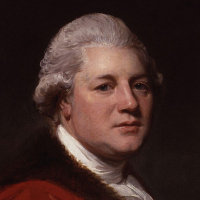 |
James Macpherson, 1736–96. Scottish poet.
Macpherson leapt to fame with the publication of the epic Fingal in 1761, supposedly the work of the Gaelic poet Ossian, discovered and translated by him. Other works by Ossian followed. Although this was later exposed as a massive forgery, the mythical world of Ossian sparked something in the early Romantic fantasy, bringing worldwide fame to his supposed discoverer.
|
 |
Anne-Louis Girodet, 1767–1824. French painter.
Girodet was a student of Jacques-Louis David's, and like him spent several years in Italy. His manner is generally more Romantic, however, with a particular interest in evocative lighting effects. In adulthood, he styles himself Girodet-Trioson, in honor of the man who adopted him (and may well have been his natural father).
|
 |
John Martin, 1789–1854. English painter.
Called "the most popular painter of his day," Martin's vast paintings of religious subjects and natural disasters later fell out of fashion.
|
 |
Elias Lönnrot, 1802–84. Finnish folklorist.
Lönnrot was "a Finnish physician, philologist. and collector of traditional Finnish oral poetry. He is best known for creating the Finnish national epic, Kalevala, (1835, enlarged 1849), from short ballads and lyric poems gathered from the Finnish oral tradition" [Wikipedia].
|
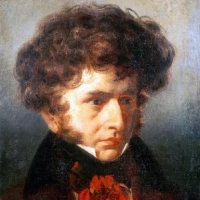 |
Hector Berlioz, 1803–69. French composer, conductor, and critic.
The leading French composer of the Romantic era, Berlioz was a master of orchestration and dramatic effect. A fervent admirer of Shakespeare (and a Shakespearean actress, Harriet Smithson), his works often have a strong literary quality that can obscure their musical craftsmanship. He was unable to get a full performance of his operatic masterpice, The Trojans (1863), but it has come into its own in recent years.
|
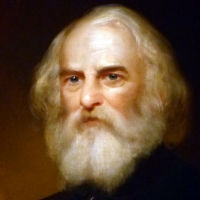 |
Henry Wadsworth Longfellow, 1807–82. American poet.
Longfellow was born in Maine, and taught at Bowdoin College and later at Harvard. His American themes and stirring diction made him the most popular poet of his day and earned him a reputation abroad. His Song of Hiawatha (1855) and similar poems employed the form of the Finnish Kalevala to create a similar Native American myth.
|
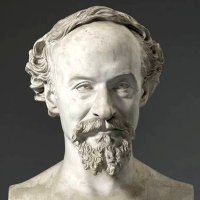 |
Knud Baade, 1808–79. Norwegian painter.
Baade was known for his paintings of Norwegian scenes, often illuminated by moonlight, creating strong dramatic contrasts. In this respect, he is somewhat similar to Caspar David Friedrich, with whom he worked in the later 1830s.
|
 |
Alfred Lord Tennyson, 1809–92. English poet.
Known for his lyrical poems and his Arthurian epic Idylls of the King, Tennyson was appointed Poet Laureate to Queen Victoria in 1850 and held the position until his death. He adopted his characteristic tone of elegiac retrospection relatively early, and carried it through a long career that established him as the most resonant voice of the Victorian era.
|
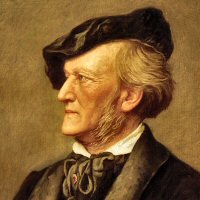 |
Richard Wagner, 1813–83. German opera composer.
Wagner almost single-handedly transformed the nature not only of opera but also of harmony and orchestration. His 10 mature operas include Tristan und Isolde (1865), Die Meistersinger von Nürnberg (1868), and the vast tetralogy Der Ring des Nibelungen (completed 1876), for which he had a special theater built at Bayreuth. His final opera, Parsifal (1882), was written for exclusive performance at that theater.
|
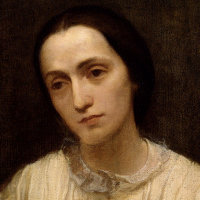 |
Julia Margaret Cameron, 1815–79. English photographer.
Julia Margaret Pattle was born in British India, and remained there until her mid-forties as a society hostess until her husband retired to England in 1845. In 1863, when she was 48, she received a box camera as a Christmas present from her daughter, as "something to amuse her." Indeed it did, and she became famous for her portraits of famous sitters, such as her neighbor Tennyson, and inventive restagings of literary works.
|
 |
Niels Gade, 1817–90. Danish composer.
A violinist, conductor, and pedagogue, Gade was the leading Danish composer of his day, becoming Director of the Copenhagen Conservatory. His musical connections extended far abroad, and he was friends with Mendelssohn, Schumann, and others. His first major work, Echoes of Ossian (1841), reflected the great fame of the supposed Gaelic bard in Denmark in the early 19th century.
|
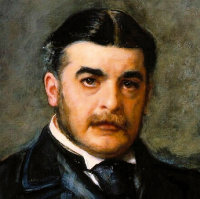 |
Arthur Seymour Sullivan, 1842–1900. English composer.
Sullivan essentially had two careers: as a classical composer of orchestra music and oratorios on suitably uplifting subjects, and as the musical partner to W. S. Gilbert on the highly successful series of Savoy Operas from HMS Pinafore (1878) to The Gondoliers (1889) and beyond. History only remembers him in the latter role.
|
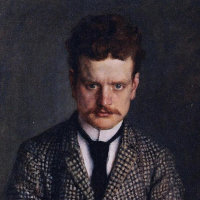 |
Jean Sibelius, 1865–1957. Finnish composer.
Sibelius "is widely regarded as his country's greatest composer, and his music is often credited with having helped Finland develop a national identity during its struggle for independence from Russia" [Wikipedia]. In addition to his seven symphonies, at least two of which have become repertoire standards, he wrote a number of tone poems based on Finnish history and myth, such as Finlandia, Tapiola, the Lemminkainen Legends, and the Karelia Suite.
|
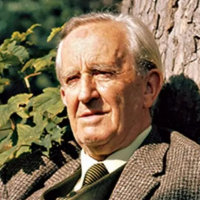 |
JRR Tolkien, 1892–1973. British novelist and scholar.
John Ronald Reuel Tolkien was Professor of Anglo-Saxon at Oxford and author of the influential fantasies The Hobbit (1939) and Lord of the Rings (completed 1955), which he said were informed in part by his study of Old English and partly by his experiences as a young officer in WW1. With CS Lewis and others, he formed the "Inklings," a discussion group of similarly-minded academics and writers that met in an Oxford pub 1930–50.
|
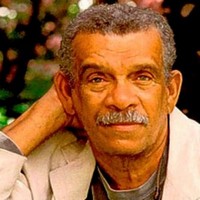 |
Derek Walcott, 1930–2017. Saint Lucian poet, playwright, and painter.
Winner of the 1992 Nobel prize in literature, Walcott was a world traveler who kept returning to his birthplace of Saint Lucia, infusing his work with Caribbean history, light, and color. His 1990 epic Omeros attempts nothing less than an overview of the African diaspora in the manner of Homer.
|
 |
George Lucas, 1944– . American filmmaker.
Writer-director George Lucas is known for the creation of two major Hollywood franchises, which between them virtually define the blockbuster genre: Star Wars (9 films, 1977– ) and Indiana Jones (5 films, 1981– ). The former, especially, involved the creation of an extensive legendarium, a complex web of characters and shared histories that form the epic background to any one of the films. He also founded several corporations such as Lucasfilm and Industrial Light and Magic, to handle the business and technical aspects of his films.
|
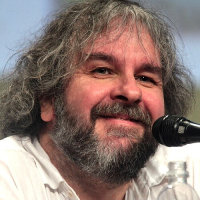 |
Peter Jackson, 1961– . New Zealand filmmaker.
Sir Peter Jackson began shooting his first film as a teenager growing up in New Zealand. The success of some of his early movies earned him an invitation to Hollywood in the mid-1990, and thence to the project which made his name, directing the Lord of the Rings trilogy (2001–03) based on the books by JRR Tolkien. He returned to Tolkien in 2012 with another trilogy based on The Hobbit.
|
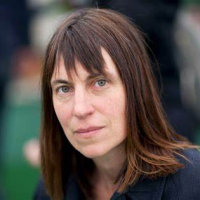 |
Alice Oswald, 1966– . English poet.
Alice Oswald studied Classics at Oxford, and later became a professional gardener; she is currently Oxford Professor of Poetry, arguably the highest honor for a British poet. Although she has published nine collections and won numerous prizes, her most famous work is Memorial (2011), subtitled "an excavation of the Iliad."
|
 |
Soon Hee Newbold, 1974– . Korean-American composer.
Born in South Korea, Newbold was adopted and raised by a family in Frederick, Maryland. She became proficient in both piano and violin as a child, and performed with orchestras up and down the country. After graduating from James Madison University, she got a job at Disney that eventually led to commissions for film scores in the epic genre. She has also worked as a conductor and director.
|


