5. Virtuosi.
This class starts with Paganini because he was the first classical musician to attain a cult celebrity at all similar
to that enjoyed by pop icons today. He was very much a product of the Romantic Era and its fascination with the
exceptional individual. And he was not alone. He inspired Franz Liszt to forge a similar career on the piano. The worlds
of Romantic opera and ballet were similarly dominated by a few exceptional stars, performing material crafted to challenge
and display their unique skills.
The fact that these performances have been perpetuated, whether through printed scores or steps handed down from
practitioner to pupil, means that anybody with the skill to attempt them today is essentially recreating the virtuosity of
the original performer, as well as displaying his or her own. We shall look at a couple of these later interpreters also,
as part of our larger enquiry into how stardom is attained, and what happens next. In many ways, each of the eight
musicians in today’s class had a similar rise to the pinnacle of success, but very different trajectories on the way down.
The script, videos, and images will be posted immediately after class.
Here are brief bios of the composers and writers considered in the class (plus in this instance a few performers), listed in
order of birth.
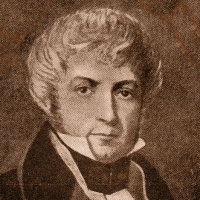 |
Manuel Garcia, 1775–1832. Spanish singer, composer, and impresario.
Born in Seville, Garcia lived in Paris 1819–23, performing the leads in several Rossini operas, as well as presenting his own. In 1825, at the invitation of Lorenzo da Ponte, he took his family plus a few other singers to New York, where they were the first to present Italian opera in America. He was the father of the singers Maria Malibran and Pauline Viardot, and the teacher Manuel Garcia jr.
|
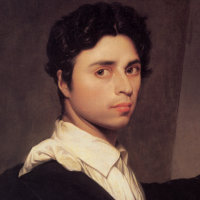 |
Jean-Dominique Ingres, 1780–1867. French painter.
Ingres was trained in the academic tradition, and indeed spent 7 years as Director of the French Academy in Rome. Although one of the great masters of French Romantic era, his style was always marked by a cool classicism and precision of line, in contrast to the freer handling of paint by his contemporary Delacroix.
|
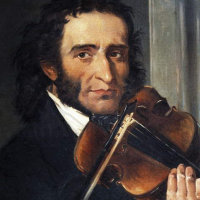 |
Niccolò Paganini, 1782–1840. Italian violinist and composer.
A virtuoso in the manner of a modern rock star, Paganini drew huge audiences wherever he played. Such was his virtuosity that he was rumored to be in league with the Devil. But there was nothing meretricious about his technique, which expanded greatly upon traditional practice, nor in the many works he wrote to play himself and challenge others.
|
 |
Isabella Colbran, 1785–1845. Italian singer and composer.
The Neapolitan Colbran was the first wife of Rossini and, in his opinion, the greatest singer of his music. It was for her that he wrote the bravura mezzo-soprano leads in many of his operas. She also published four volumes of songs dedicated to various noble patrons, considerably less difficult than those that she herself sang, but with a charming musicality.
|
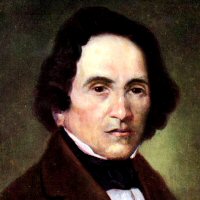 |
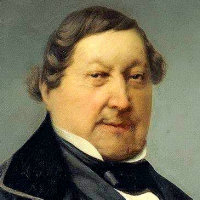
Giacomo Meyerbeer, 1791–1864. German composer working in France.
Although born and trained in Germany, Meyerbeer began his prolific opera career in Italy, falling under the spell of the serious operas of Rossini. He moved to Paris in 1826 and began a series of operas that essentially defined the notion of Grand Opera, among them Robert le Diable (1831), Les Huguenots (1836), Le Prophète (1849), and L'Africaine (1865).
|
 |
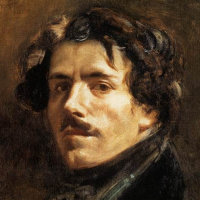
Gioacchino Rossini, 1792–1868. Italian composer.
Rossini's fame rests on his 39 operas, especially the comedies, all written while he was still in his thirties. In 1829, fter writing Guillaume Tell, one of the foundation stones of French grand opéra, he essentially retired, settling in Paris, and writing only occasional pieces plus his masterpieces of sacred music, the Stabat Mater of 1842 and Petite Messe solennelle of 1864.
|
 |
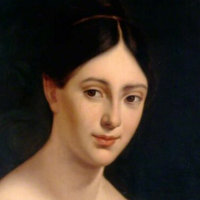
Eugène Delacroix, 1798–1863. French painter.
The leading French painter of the Romantic movement, he is known for his brilliant Rubensian color and his dramatic compositions. Especially in the first half of his career, these included political themes, such as The Massacre at Chios (1824) and Liberty Leading the People (1830), as well as subjects from Romantic literature. He also visited North Africa, and was constantly fascinated by the exotic.
|
 |
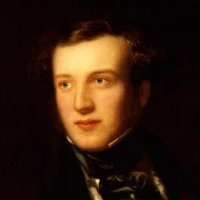
Maria Malibran, 1808–36. Spanish singer.
The daughter of Manuel Garcia, Malibran quickly became one of the leading divas of bel canto opera; a single benefit performance in Venice was sufficient to rebuild the dilapidated old theater as the Teatro Malibran. Donizetti wrote the title role in Maria Stuarda for her. She moved to England in 1834 and died in Manchester two years later of complications from a riding accident.
|
 |
Michael Balfe, 1808–70. Irish composer.
Balfe was born in Dublin and studied voice and violin. His singing career took him to Paris, Milan, and London, where he also began to get his own operas produced. The Bohemian Girl (1843), his greatest success (containing the air "I dreamt that I dwelt in marble halls") was produced in translation all over Europe, and even returned to London as an Italian opera!
|
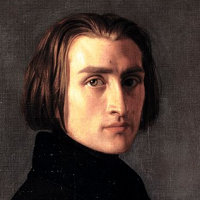 |
Franz Liszt, 1811–86. Hungarian composer.
Liszt was the foremost piano virtuoso of his time, playing three or four concerts a week during his heyday during the 1840s, and much of his prolific output—including notably his set of 19 Hungarian Rhapsodies—is designed for display. But he was also a generous supporter of numerous other musicians, including Chopin, Schumann, Berlioz, Grieg, Borodin, and Wagner (who became his son-in-law). Many of his compositional techniques in his later works paved the way for advanced composers at the turn of the century,
|
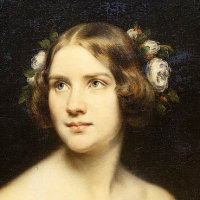 |
Jenny Lind, 1820–87. Swedish singer.
A child prodigy, Lind sang heavy roles too young, but her voice was repaired by Manuel Garcia jr. After that, she specialized in roles that highlighted the limpid purity of her voice, earning the nickname of "The Swedish Nightingale," under which PT Barnum billed her for a grand tour of America (1850–52). This garnered her the equivalent of pop superstardom, launching brand-name merchandise of every kind and earning her over $13 million (in today's values), which she used to establishing charity schools in Sweden.
|
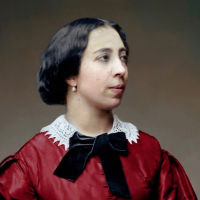 |
Pauline Viardot-Garcia, 1821–1910. French singer and composer.
The daughter of opera singers, Pauline Garcia was one of the divas of the day. In this, she followed in the footsteps of her sister Maria Malibran, though speciaizing in more dramatic roles. Berlioz made his edition of Gluck's Orfeo ed Euridice for her, and Brahms wrote his Alto Rhapsody. She retired from the stage in 1863 and devoted herself to composing, writing five chamber operas and numerous songs.
|
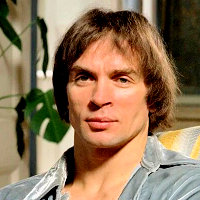 |
Rudolf Nureyev, 1938–93. Russian dancer.
Nureyev's musicality, physique, and technical wizardry made him a star of he Kirov Ballet before he was 20. He defected on a Kirov tour to Paris in 1861, and soon after joined the Royal Ballet in London. His presence had an extraordinary catalytic effect on the company, especially its prima balerina Margot Fonteyn, making their partnership world famous. In his last decade, before dying of AIDS, he was Director of the Paris Opera Ballet, creating some new works and resurrecting many others.
|
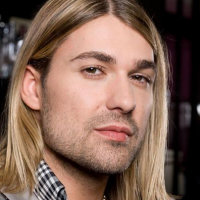 |
David Garrett, 1980– . German violinist.
The son of a German jurist, Georg Bongartz, and an American ballerina, Dove Garrett, David took his mother's name when performing. He was a child prodigy, playing for the German President at 11 and signing a contract with Deutsche Grammophon at 13. He later studied at Juilliard in New York, making extra money on the side as a male model. He portayed (and played) Paganini in the 2013 movie The Devil's Violinist. His later career has been mainly in the crossover genre, presenting a glamorous mixture of classical and pop.
|


