9. Closing Acts.
Just occasionally, a long record of success will enable an artist to step aside at the end of his life and produce
something for himself. So we get Shakespeare with The Tempest, Michelangelo chipping away at a
block of marble to find the truth within, Rembrandt seeking spiritual understanding, or Beethoven
combining the profound with the jocular in his last Quartets.
Three other pairs of artists fill this picture out: Verdi and Britten ending their careers with intensely
personal operas quite different from any they had written before; Monet and Matisse overcoming disabilities
that would have stopped lesser artists in their tracks; and Fellini and Altman coming off a string of
successes to make movies that celebrate their own personal fantasies.
The script, videos, and images will be posted immediately after class.
Q AND A
Who are the people in The Return of the Prodigal Son?
Despite what I had thought, the general consensus is that the tall figure on the right is indeed the censorious elder son, who
had done everything he was supposed to do in duty to his father, but never received a similar feast in his honor. In the
Bible, he boycotts the feast for his younger brother, and vents his resentment on his father when he goes out to fetch him in.
Several commentators remark that, in a sense, both sons in this family are lost, and that the story is not truly completed
until both are accounted for. So Rembrandt's painting contains both an answer and a question.
What is the spiritual meaning of the story?
Look the Rembrandt painting up on Google, and you will find a host of articles. A few of these are objective art-history, but many writers use the painting
as an object lesson in a Biblical sermon. Trained as I am both as an art-historian and (as a child) in Bible study, I find the combination
of the two approaches unhelpful. But one book that manages to balance the two aspects superbly, I think, is the one I mentioned by the
Dutch priest Henri Nouwen: The Return of the Prodigal Son. The link
is to Amazon, where you can buy the book for under $10. I strongly recommend it.
What is going on in the picture below?

This appears to be a late-1800s variant on the Rembrandt by an American Artist, Henry Mosler, working in France. Despite the
similarities, there are obvious differences. It is hard to know if the painter is being cynical, or merely realist, or has
completely misunderstood the Bible story, as Randy Newman, the author of the online article, suggests. Unfortunately, this is another of those pieces
that turns into an Evangelical sermon, but the opening page or two before it does are well-written and interesting.
VIDEO LINKS
Most clips shown in class are available in one form or another, often at greater length than I was able to show. However,
I have only trailers of the RSC/Intel Tempest production or the Donmar Warhouse all-female one with Harriet Walter,
but but both include at least glimmpses of the scenes shown. I added two good discussions of the Rembrandt Prodigal
Son, plus an extraordinary three-dimensional replica of it that comes, I think, from some Christian site, but only
manages the total opposite: to erase Rembrandt's spirituality completely!
The Tony Palmer film of Death in Venice is available complete, but in poor quality and with obtrusive Italian
titles; all the same, I added one extra scene that shows Aschenbach's infatuation; the all-important final scene, though,
is in better quality. Similarly, the Falstaff production we saw in class (from a DVD) is on YouTube only in
abysmal quality, but I compensate with excellent videos from a traditional production and the updated Robert Carsen one
at the Met. All the videos from the second hour are avalable as shown. Items that we did not see in class are
*asterisked.
| A. FINAL CURTAIN |
| |
Shakespeare: The Tempest |
|
* Trailer of 2016 RSC production
(Gregory Doran with Intel)
* David Threlfall as Prospero
("Our revels now are ended")
* Harriet Walter as Prospero
(Trailer of all-female production)
|
| |
Beethoven: Quartet, Op.135 |
|
* Themes in last movement
(own video)
* Last movement
(Ariel Quartet)
|
| B. SPIRITUAL INSIGHT |
| |
Michelangelo: Rondanini Pietà |
|
* Video tour
(Milan, Castello Sforzesco)
|
| |
Rembrandt: Prodigal Son |
|
* The painting in Rembrandt's career
* Its spiritual implications
* Replica
(three-dimensional replica!)
|
| C. GOING OUT IN STYLE |
| |
Britten: Death in Venice |
|
* Aschenbach sees Tadziu
(Tony Palmer film, Italian titles)
* Aschenbach pursues Tadziu
(Tony Palmer film, Italian titles)
* Final Scene
(Tony Palmer film, no titles)
|
| |
Verdi: Falstaff |
|
* Finale, as seen in class
(poor quality, titles in Spanish)
* Finale, from Solti DVD
(Bacquier/Solti/Friedrich, with titles )
* Finale, Metropolitan Opera
(fugue only, with titles)
|
| D. WHAT DISABILITIES? |
| |
Claude Monet |
|
* Water lilies, video shown in class
(German speaker enters at 2:55)
* Water lillies, general
(own video)
|
| |
Henri Matisse |
|
* Cutting paper
* Montage of papiers coupés
(own video)
|
| E. THE DIRECTOR DOES AS HE PLEASES |
| |
Federico Fellini |
|
* E la nave va, quasi-trailer
* E la nave va, ending
(last third, cued to start in class)
* La voce della luna, disco/waltz
|
| |
Robert Altman |
|
* The Company, "As the world turns"
* A Prairie Home Companion, opening
* A Prairie Home Companion, ending
|
| |
|
|
|
|
|
| IMAGES |
The thumbnails below cover the slides shown in class, though
there may be a few small discrepancies.
Click the thumbnail to see a larger image.
Click on the right
or left of the larger picture to go forward or back, or outside it to close. |
 | |
 | |
 | |
 | |
 | |
 | |
 | |
 | |
 | |
 | |
 | |
 | |
 | |
 | |
 | |
 | |
 | |
 | |
 | |
 | |
 | |
 | |
 | |
 | |
 | |
 | |
 | |
 | |
 | |
 | |
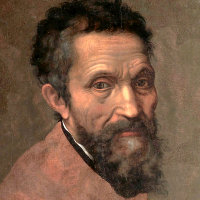 |
Michelangelo Buonarroti, 1475–1564. Florentine sculptor, architect, painter, and poet.
A towering universal genius, his work virtually defines the Italian High Renaissance. He made his name primarily as a sculptor in his native Florence, though he worked elsewhere as well. His most famous works, however, are in Rome: the ceiling of the Sistine Chapel (1508–12) and his work from 1546 as leading architect of the Basilica of St. Peters, one of a succession of masters who brought the building to its present form.
|
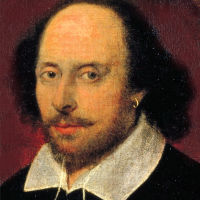 |
William Shakespeare, 1564–1616. English poet and playwright.
With almost 40 plays, 154 sonnets, and many longer poems, Shakespeare dominates English literature of his time, and world literature for ever after. To attempt a thumbnail biography would be both unnecessary and impossible.
|
 |
Rembrandt Harmenzoon van Rijn, 1606–69. Dutch painter and printmaker.
The greatest artist of the Dutch Golden Age, he nonetheless retained his own style which set him apart from his contemporaries. There is a strong baroque influence earlier in his career, but his later work developed a quality of deep introspection in which the subject seems to glow within rich layers of paint.
|
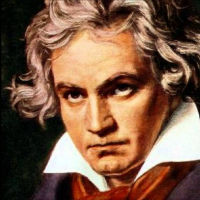 |
Ludwig van Beethoven, 1770–1827. German composer, working primarily in Vienna.
The dominant composer of his time, Beethoven wrote 9 symphonies, 16 string quartets, 32 piano sonatas, and one opera, Fidelio, which he labored on in several versions between 1805 and 1814. From about 1800 onwards, increasing deafness gradually put an end to his performing career, although he wrote some of his finest works when totally deaf. He is one of the first composers to exhibit a distinct late style.
|
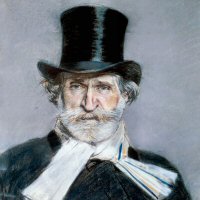 |
Giuseppe Verdi, 1813–1901. Italian opera composer.
Verdi's two dozen or more operas (depending on how you count them) make him the leading Italian opera composer of his time and among the two or three greatest opera composers ever. After what he called his "years in the galleys," he hit his stride in the early 1850s with the trio of Rigoletto, Il Trovatore, and La Traviata. He intended Aïda (1870) to be his last work, but was persuaded out of retirement to write his final Shakespearean masterpieces: Otello (1886) and Falstaff (1893).
|
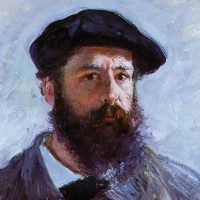 |
Claude Monet, 1840–1926. French painter.
The central figure in Impressionism (it was his Impression: Sunrise of 1872 that gave the movement its name), he intensified its focus more than any other artist, continuing well into the next century to produce series of paintings showing minute variations in the light and color in basically the same scene. Cézanne famously said of him, "Monet is nothing but an eye—but my God, what an eye!"
|
 |
Thomas Mann, 1875–1955. German novelist.
Winner of the 1929 Nobel prize in literature, Mann's best-known works date from before he fled from Germany in 1933: these include the novels Budenbrooks and The Magic Mountain and the novella Death in Venice. Eventually settling in America, he continued to write until his death.
|
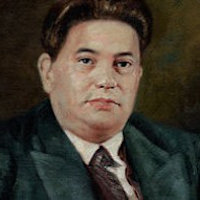 |
Darius Milhaud, 1892–1974. French composer.
A member of Les Six (with Satie, Poulenc, and others), Milhaud was a prolific composer in all media, noted for his early use of jazz and his experiments in polytonality and unusual instrumental combinations.
|
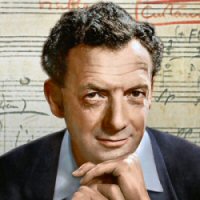 |
Benjamin Britten, 1913–76. English composer.
Arguably the leading opera composer of the mid-20th century, Britten's major operas have included Peter Grimes (1945), Billy Budd (1951), Gloriana (1953), A Midsummer Night's Dream (1960), and Death in Venice (1973), plus many stage works for smaller forces. He was equally active as a composer of instrumental music and text settings, and latterly as a conductor and accompanist.
|
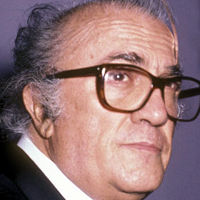 |
Federico Fellini, 1920–93. Italian film director.
After a brief stint as a law student to please his parents, Fellini broke out as a cartoonist, writer, and later filmmaker. Beginning in the neo-realist style with works like La strada (1954), he gradually moved towards the more fantastic treatment that defined his style, in films like La dolce vita (1960), 8½ (1963), and Amarcord (1973). He is commonly listed among the greatest directors ever.
|
 |
Robert Altman, 1925–2006. American film director.
Internationally honored as one of the great directors of all time, Altman was known for his large-cast free-form projects that tied many short glimpses together into a complex tapestry. His most famous films include M*A*S*H* (1970), Nashville (1975), and Gosford Park (2001).
|


