10. Yesterday's Modernists.
TS Eliot, Henry Moore, Francis Bacon, Peter Maxwell Davies, all leading modernists when I was still living in Great
Britain, their names widely known even if their works appealed only to a more esoteric audience. Are they still names
to conjure with now? Or is yesterday’s modernism today’s old news?
We shall find different trajectories in each case. Towards the end of his life, Eliot wrote for wider audiences,
such as the West End theatre, but his Grand Old Man status may have worked against him after his death. Moore made
no concessions in later life, but ploughed all his money into a foundation that has ensured the continuity of his own work
and supported others. Rather than popular, Bacon became more private in his later work, but his obsession was
rewarded with posthumous sale prices going through the roof. Maxwell Davies, arguably the most radical of all when
he started out, definitely mellowed in later years, helped in part by his move to the distant Orkney Islands.
The script, videos, and images will be posted immediately after class.
VIDEO LINKS
All the clips shown in class are available on YouTube, excepting only the Ralph Fiennes Four Quartets, though
there is a good trailer of that. Almost all the links below are to much longer videos than I could play in class,
though they are cued to where we started if it was not the beginning.
I made a few *additions, namely two more versions of all or parts of the Four Quartets,
other documentaries on TS Eliot and Henry Moore, and a lot of other pieces by Peter Maxwell Davies to fill out my point that his
earlier music was challenging, his later work markedly less so. I would call your attention especially to the documentary The
Valley by the Sea, which is narrated by a famous Orcadian poet, George Mackay Brown, and tells of how Max came to the
islands almost by accident, and found a home there. Note especially the section
where he discovers that the Orkney landscape had been sneaking into his music, without him even knowing it!
| |
|
|
|
|
|
| IMAGES |
The thumbnails below cover the slides shown in class, though
there may be a few small discrepancies.
Click the thumbnail to see a larger image.
Click on the right
or left of the larger picture to go forward or back, or outside it to close. |
 | |
 | |
 | |
 | |
 | |
 | |
 | |
 | |
 | |
 | |
 | |
 | |
 | |
 | |
 | |
 | |
 | |
 | |
 | |
 | |
 | |
 | |
 | |
 | |
 | |
 | |
 | |
 | |
 | |
 | |
Here are brief bios of the composers and writers considered in the class, listed in order of birth.
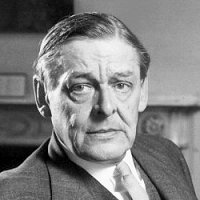 |
Thoman Stearns (T.S.) Eliot, 1888–1965. American-British poet.
One of the leading modernist poets of the 20th century, known for works such as The Waste Land (1922) and Four Quartets (1936–42), Eliot also found success in the theatre with works such as Murder in the Cathedral (1935). His light verse collection Old Possum's Book of Practical Cats (1939) was the source for Andrew Lloyd Webber's Cats.
|
 |
Henry Moore, 1898–1986. British sculptor.
Born in a mining village in Northern England, Moore obtained scholarships to study in Leeds and later in London. His earlier work. though figurative, was influenced equally by primitive sources and the abstraction of his European contemporaries. His work documenting people sheltering from the Blitz in the London Underground brought him to wider attention. After the war, he received commissions internationally, producing work that, though still often abstract, was closely tied to natural forms and the surrounding landscape.
|
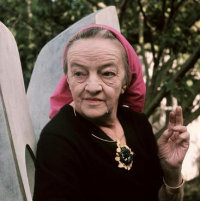 |
Barbara Hepworth, 1903–75. British sculptor.
Hepworth was a fellow student with Henry Moore at the Leeds College of Art, and a lifelong friend. Her work, however, tends to be less elemental, more elegant than his. Through her second husband, painter Ben Nicholson, she became closely connected with modernism in continental Europe, and the couple were the founding members of the St Ives School in Cornwall, where they moved during the War.
|
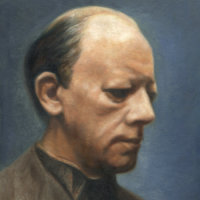 |
Alan Rawsthorne, 1905–71. British composer.
Although steered by his family away from music, Rawsthorne eventually enrolled in the Royal Manchester College of Music as a pianist and cellist. His career, however, took off as a composer with some international successes before WW2, and a large number of film scores after it.
|
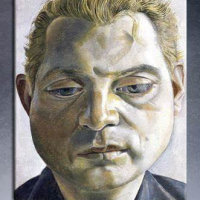 |
Francis Bacon, 1909–92. British painter.
Bacon was born in Dublin to English parents, but left home in his teens to move to London and thence to Paris. He had no formal training as a painter, but when he emerged in 1945 with Three Studies for Figures at the Base of a Crucifixion, he both galvanized and divided critics by the fierceness of his imagination and savagery of his style. Alan Bowness, the former director of the Tate, wrote that "no artist in our century has presented the human predicament with such insight and feeling."
|
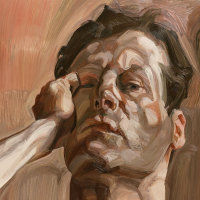 |
Lucian Freud, 1922–2011. German-English painter.
Born in Berlin, the grandson of Sigmund Freud, Lucian came to Britain in 1931 with his parents and became a British citizen in 1939. One of the leading representational painters in postwar Britain, he was also her leading portraitist, albeit in an uncompromising and less traditional style.
|
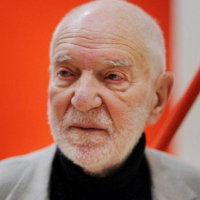 |
Anthony Caro, 1924–2013. British sculptor.
Caro worked briefly as an architectural assistant and took a degree in Engineering from Cambridge before becoming a sculptor. He was assistant to Henry Moore (1951–53), and later traveled to America on a Ford Foundation Scholarship, coming into contact with members of the Abstract Expressionist movement. His work typically consists of assemblages of industrial steel elements painted in bright flat colors.
|
 |
Peter Maxwell Davies, 1934–2016. British composer.
Sir Peter Maxwell Davies was Master of the Queen's Music (composer laureate) for the last decade of his life, celebrating his by-then establishment status. But he began as a radical, writing works such as Eight Songs for a Mad King that stretched the boundaries of performance practice. Like Britten, he has always liked working for specific performers and places, including many works for his adopted home of Orkney to the North of Scotland.
|
 |
Dudley Moore, 1935–2002. British composer, comedian, and actor.
After graduating from Oxford, where he was an organ scholar, Moore made a living as a cabaret pianist and composer. His breakthrough came as a member of the four-person review Beyond the Fringe in 1960. With fellow Fringe performer Peter Cook, he had a long-running comedy show on British television before moving to Hollywood for such films as 10 (1971) and Arthur (1981). By the mid-1990s, however, he was beginning to suffer from the cerebral palsy that would eventually end his life.
|


