11. Masters of a Lesser Medium?
For five decades, Norman Rockwell (1894–1978) painted covers for The Saturday Evening Post, earning him a special
place as an acute observer of American life and values. Although magazine illustration is seldom considered one of the so-called
fine arts, Rockwell stands up well to evaluation as an artist pure and simple. At the start of his long career, Bob Dylan
(1941– ) would have been classified as a folk musician and singer of protest songs that gave voice to the counterculture of his
time. Yet in 2016, he was awarded the Nobel Prize for Literature. They will occupy our first hour.
In the second, we shall enquire why zany comedian Jerry Lewis (1926–2017) should have been hailed a genius by cinéastes
in France, where he was awarded the Légion d’Honneur.* As context, we will compare him with two
other popular but similarly-lionized filmmakers, Charlie Chaplin (1889–1977) and Alfred Hitchcock (1899–1980), looking
especially at their later careers.
*In regard to the popularity of Jerry Lewis in France, you might care to read this
article about a major retrospective of the artist' work at the Cannes Film
Festival in 2013. It is quite short, and explains a lot.
The script, videos, and images will be posted immediately after class.
Q AND A
What about Jerry Lewis as a straight actor?
I didn't know Martin Scorcese's 1982 film The King of Comedy. It is interesting in that the comedian trying to establish
himself in the business is not played by Jerry Lewis, as you might expect, but Robert de Niro, whom you seldom see in
such a role. Jerry Lewis is Jerry Langford, a former comedian turned late-night host—in other words, basically playing
himself at this stage of his career, but quite straight. The Wikipedia article is
here,
there is an an extended video analysis here,
and the complete movie is available here.
VIDEO LINKS
Everything shown in class is also available online, plus a great deal more. So much, in fact, that I had to be quite selective
in choosing what extra material to add. Since there is so much of it, *asterisks indicate clips
that were shown in class.
• ROCKWELL. I showed no videos for Norman Rockwell, but have added a few of general interest below: three documentaries of
various lengths, plus one of those iPhone-format shorts that directly addresses his attitude to race. Note that the
presenter at one point misspeaks by saying "Washington Post" when she means Saturday Evening Post.
• DYLAN. There are two excellent videos that explore Bob Dylan's earlier career in detail. In class, I showed two clips from
Martin Scorcese's three-hour documentary No Direction Home. There is also the recent biopic starring Tiomothée
Chalamet, A Complete Unknown. For this, and for any music clips, I have concentrated on the three songs we looked at
in class, but there is lots more.
• CHAPLIN. I added two shortish biographies and a good longer one—also a clever AI bio that goes through his life in reverse
order! I added extra scenes from The Kid, plus the complete film and a later interview with Jackie Coogan who played
the title role as a child. I also added scenes from The Great Dictator, but there is an enormous amount out there.
• HITCHCOCK. Once again, I focused on the movies we actually discussed, plus his first film The Pleasure Garden and
also Psycho. I added a similar selection of bios, plus a few of the many videos on Hitchcock's technique, whether
analyzed by others or explained by the master himself. And also a compilation of his signature cameo appearances!
• LEWIS. I was rather sparing with these clips, mainly because I felt a little goes a long way. But I would draw your attention
to the distinguished obituary tribute from TCM, and also the material on the telethons. For the rest, I have just added a few
extra scenes with Dean Martin, plus a fan compilation from The Nutty Professor. If you look on YouTube, you will also
find a lot about Lewis's "dark side," which I acknowledge but saw no need to include. See also Q&A above.
I also attach two articles. One, Le grand Jerry Lewis, which I posted before
class, is a newspaper piece addressing the mystery of Jerry's popularity in France. The other,
Rediscovering Charlie Chaplin, is long, somewhat academic, but well worth
while. Starting off as a review of the notes and other materials accompanying some major Chaplin box sets in 2004, it goes into the
actor-director's work in perceptive detail that might not be for everyone, but I found stimulating throughout. rb.
| |
|
|
|
|
|
| IMAGES |
The thumbnails below cover the slides shown in class, though
there may be a few small discrepancies.
Click the thumbnail to see a larger image.
Click on the right
or left of the larger picture to go forward or back, or outside it to close. |
 | |
 | |
 | |
 | |
 | |
 | |
 | |
 | |
 | |
 | |
 | |
 | |
 | |
 | |
 | |
 | |
 | |
 | |
 | |
 | |
 | |
 | |
 | |
 | |
 | |
 | |
 | |
 | |
 | |
 | |
Here are brief bios of the artists considered in the class, listed in order of birth.
 |
Charlie Chaplin, 1889–1977. English film director and actor.
Chaplin grew up in poverty in the East End of London. He began working in music halls as a teenager, and at 19 joined the Karno Company, which took him to America. It was not long before his character "The Tramp" had become an icon of the silent movie comedy. Chaplin did not speak on film until The Great Dictator of 1940. Even though this was a satire of Hitler, Chaplin was accused of Communist sympathies by Herbert Hoover, causing him to leave America and settle in Switzerland, where he occupied himself writing music for many of his earlier movies and making a few new films, which were generally not so well received.
|
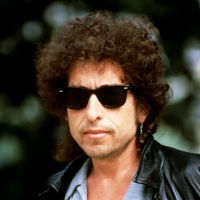 |
Bob Dylan, 1941– . American singer-songwriter, author, and artist.
His songs of the 1960's such as "Blowin' in the Wind" became anthems of the Civil Rights movement, but he has continued writing in many genres ever since. He was awarded the Nobel Prize in Literature in 2016.
|
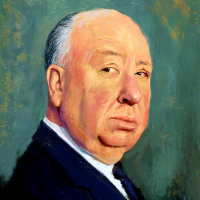 |
Alfred Hitchcock, 1899–1980. British-American film director.
Hitchcock began in the silent cinema as a title-card designer, but soon rose to direct his own films, from The Lodger in 1927 to Frenzy in 1972. Called the "Master of Suspense," he specialized in mystery-thrillers in which ingenious plot twists are matched by innovative uses of the camera. He also hosted his own television series between 1955 and 1965. He is known for "signing" many of his films by brief cameo appearances.
|
 |
Jerry Lewis, 1926–2017. American actor and film director.
Wikipedia writes: "Rising to prominence with singer Dean Martin, Lewis did a series of sixteen buddy-comedy films, television shows, and a radio series until their split in 1956. Lewis went into filmmaking while continuing on his own in thirty-five motion pictures from 1957 to 1984." Hailed as a genius by French critis, he was awarded the Légion d'honneur in 2006. As its honorary national chairman, Lewis raised funds for the Muscular Dystrophy Association through his annual Labor Day Telethon netween 1966 and 2011.
|
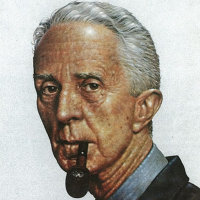 |
Norman Rockwell, 1894–1978. American painter and illustrator.
Rockwell began working as a professional illustrator at 18, and continued to become one of America's best-loved artists. His success had partly to do with the circulation of the periodicals (notably The Saturday Evening Post) that had him on their covers, and partly for his depiction of a family-friendly folksy America, but he was also an accomplished artist who could tackle serious subjects like racial and social injustice.
|


