1. Three Home Towns.
Before crossing to Europe, we might establish some criteria by considering three towns here in the United
States: New Orleans (founded 1718), Washington DC (1790), and Chicago (1830). Each
has a distinct atmosphere. Each grew up at a particular place and time for different reasons, and each
plays a different role in the life of this country. While all three are tourist destinations, each takes
pains to preserve and promote a particular image; how does this image—its Sense of Place—relate
to the origin, location, and purpose of the city?
In preparing for this class, you might think about your own impressions of each city. What words would you
use to describe its atmosphere? Does it seem in any way like a time-warp, transporting you to a different
period? And how much do the arts that you find there—both past and present, and including architecture and
planning—contribute to these impressions?
The script, videos, and images will be posted immediately after class.
Q AND A
Whar do you expect this course to offer?
Probably not much new in the way of facts, but hopefully a lot in the way of attitude. The cities I have chosen are all
well-known and although I'm sure I can provide a lot of interesting details, I would not consider myself an expert in
the history of any of them. What I think I can do is suggest new ways of looking, pulling things together from a lot of
different sources, and looking further into the question of why some places make such a deep impression on us.
How much of this has to do with the arts in each place?
I am aware that my own professions, first as art hsitorian and then as opera director, gave me a very peculiar way of
looking at these cities on my first visits, quite different from that of an occasional tourist. So I have tried to
find a balance between what you would see in the museums of a city and what you would experience by walking in the
streets. See also the next question.
Is this also what you mean by the "curatorial" and "creative" roles of a city?
Yes. When I first started working on this course, I thought I could make a binary distinction between art that was created in a city and the art housed in it. But I see now that this is a three-part distinction at least:
1. world art that has found its way into the museums of a city through donation or purchase;
2. art that has been created in the city in the past, whether or not it actually remains there;
3. the creative fervor within the city today.
Categories 2 and 3 both relect the culture of the city, and will thus be my main focus.
VIDEO LINKS
All the clips shown in class came from YouTube, and all are available via the links below, often at greater length
than I was able to show. I have added a few other relevant clips, marked with an *asterisk.
Among these are articles on the founding and culture of New Orleans, two iconic works commissioned for Washington
premieres, much more on the Chicago World's Fair, and two samples of theater in Chicago, a vibrant part of the
cutural landscape that I was unable to show in the class itself. rb.
| NEW ORLEANS |
| |
History |
|
* Founding of New Orleans
(interesting online article)
|
| |
City Life |
|
* Welcome to New Orleans
(CBS Sunday Morning)
* If Cities Could Dance
(about the Second Line)
* Drum Circle, Congo Square
(spontaneous community music)
* Culture of New Orleans
(good Wikipedia article)
|
| |
Jazz |
|
* The Birthplace of Jazz
(interesting documentary)
* Jazz funeral (real)
* Jazz funeral (demo)
* Tuba Skinny Jubilee Stomp
|
| |
Non-Jazz Music |
|
* Trendafilka: Chichovite Konye
* Contemporary Music in New Orleans
(compilation including the above)
|
| WASHINGON DC |
| |
The City |
|
* Welcome to Washingon 1
(official promo)
* Welcome to Washingon 2
(official promo)
|
| |
National Gallery of Art |
|
* Tour 1
* Tour 2
(cued to tunnel section)
|
| |
Commissioned for DC |
|
* Stravinsky: Dumbarton Oaks, 1937
(opening used in class)
* Copland: Appalachian Spring, 1944
(Martha Graham ballet, B&W)
|
| CHICAGO |
| |
The City |
|
* Let's Go, Chicago!
(Beautiful Destinations)
* Madison and State, 1897
(Edison films)
|
| |
World Fair, 1897 |
|
* 11-minute documentary
* 2-hour documentary
(opening shown in class)
|
| |
Art |
|
* Ferris Bueller's Day Off
(Art Institute scene)
|
| |
Literature |
|
* Sandburg: Chicago
(Gary Sinise, audio)
* Studs Terkel on Working
* Schwartz: Working, trailer
(2017, London)
* Adam Gottlieb: "Poet, breathe now"
(Louder Than a Bomb)
|
| |
Theatre |
|
* Goodman Theatre: Ashland Avenue
(trailer)
* Second City, home of improv
(Steve Carrell)
|
| |
|
|
|
|
|
| IMAGES |
The thumbnails below cover the slides shown in class, plus the
individual images in some of the montages. Click the thumbnail to see a larger image.
Click on the right
or left of the larger picture to go forward or back, or outside it to close. |
 | |
 | |
 | |
 | |
 | |
 | |
 | |
 | |
 | |
 | |
 | |
 | |
 | |
 | |
 | |
 | |
 | |
 | |
 | |
 | |
 | |
 | |
 | |
 | |
 | |
 | |
 | |
 | |
 | |
 | |
 | |
 | |
 | |
 | |
 | |
 | |
 | |
 | |
 | |
Here are brief bios of the composers and writers considered in the class, listed in order of birth.
 |
Pierre Charles L’Enfant, 1754–1825. French engineer.
Born in Paris, L'Enfant was recruited by the French playwright Beaumarchais to serve in the American Continental Army, where he became military engineer to George Washington, who later commissioned him to draw up plans for the new capital city bearing his name. Although he did not personally supervise most details of its execution, his plan is very largely still in place today.
|
 |
Dankmar Adler, 1844–1900. German-American architect.
Born in Germany, Adler was brought to the US at age 10 by his widowed father, a rabbi. After service as an engineer in the Civil War, he went into private practice as an architect. His greatest renown comes from his partnership with Louis Sullivan on a number of pioneering skyscraper buildings, including the Wainwright Building in St. Louis (1891), the Chicago Stock Exchange Building (1894), and the Guaranty Building in Buffalo (1896).
|
 |
Daniel Hudson Burnham, 1846–1912. American architect.
Raised in Chicago, Burnham tried several occupations before setting up as an architect with John Root in 1871. They were responsible for the first multi-storey steel-frame buildings, popularly known as skyscrapers. The firm was charged with design of the site of the 1893 World's Columbian Exhibition in Chicago; Root died, but Burnham showed his organizational skills by recruiting other architects from all over the county and bringing the project—known as The White City—in on time.
|
 |
Thomas Edison, 1847–1931. American inventor.
Edison is one of those prolific figures whose creations penerated society fo deeply that even the longest biography will seem too short. He was born in Ohio, grew up in Michigan, and settled in New Jersey, where he built the first research laboratory at Menlo Park. His 1,093 US patents include work in telegraphy, electric power generation. sound recording, and motion pictures.
|
 |
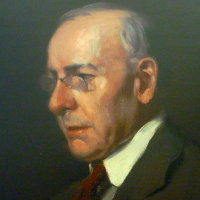
John Wellborn Root, 1850–91. American architect.
Though born in Georgia, Root studied in Liverpool, England, where he got to know the work of Peter Ellis, designer of the world's first two metal-framed curtain-walled buildings. He would develop these ideas later in Chicago, with his partner Daniel Burham, to create the first American skyscrapers.
|
 |
Louis Sullivan, 1856–1924. American architect.
Sullivan moved to Chicago in 1873 to join building boom following the Great Fire of 1871. After various short residencies to learn his craft, he became the partner of Dankmar Adler in 1880. Together, they designed many theater buildings and commercial blocks that became some of the first skyscrapers. He is credited with the phrase "form follows function," but his own relatively austere forms were illuminated with details that are pure are and nothing to do with function at all.
|
 |
Frank Lloyd Wright, 1867–1959. American architect.
Wright designed over 1,000 buildings, including the iconic Fallingwater (1937) and Guggenheim Museum (1959). Beginning with the Ward Willits House in Chicago (1902), he developed what became known as the Prairie School of architecture, featuring long low verticals and close integration of buildings with their environment, principles that he developed further in connection with Broadacre City, a pioneer of planned suburban development.
|
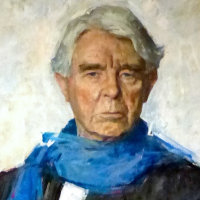 |
Carl Sandburg, 1878–1967. American poet and biographer.
Sandburg won two Pulitzer Prizes for his poetry and one for his biography of Abraham Lincoln. He began his writing career as a journalist on the Chicago Daily News, and many of his poems paint a realistic, but basically optimistic, portrait of city life.
|
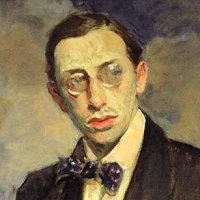 |
Igor Stravinsky, 1882–1971. Russian-American composer.
Starting as an enfant terrible in Paris with the ballets he wrote for Serge Diaghilev, he gradually pared back his resources, developing a neo-classical style between about 1930 and 1955, but eventually turning his back on tonality.
|
 |
Studs Terkel, 1912–2008. American oral historian and broadcaster.
Although Terkel has a law degree, he decided he wanted to be a hotel concierge instead. Throughout his long career, mainly in Chicago, he has maintained contact with ordinary people, featuring them on his daily radio show, which ran for 45 years, or transcribing their voices in a series of oral histories for which he received he Pulitzer Prize: Hard Times (1970, about the Great Depression), Working (1974, people talking about their jobs), and The Good War (1984, about the WW1).
|
 |
Ieoh Ming Pei, 1917–2019. Chinese-American architect.
Born in China, IM Pei studied at MIT and then Harvard, with Marcel Breuer and Walter Gropius. He established his own design NYC firm in 1955. His notable buildings include the John F. Kennedy Library in Boston (1977), the East Wing of the National Gallery in Washington (1978), and the pyramids and associated structures at the Louvre in Paris (1988).
|
 |
Stephen Schwartz, 1948– . American composer and lyricist.
Schwartz is the composer of many Broadway musicals ncluding Godspell (1971), Pippin (1972), and Wicked (2003). In 1978, he made a musical-theater adaptation of Studs Terkel's Working. Born in NYC, he is a graduate of Carnegie-Mellon University in Pittsburgh.
|
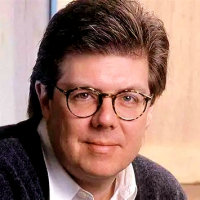 |
John Hughes, 1950–2009. American film director.
Born in Michigan, Hughes moved with his family to Chicago in his early teens. Many of the films that he both wrote and directed are set in Chicago and reflect the adolescent experience. They include Ferris Bueller's Day Off (1986) and Home Alone (1990).
|


