2. Bruges: the Dead City?
This one is personal. Though Bruges is the only city in the course that I have visited only once, it left an indelible
impression. It is sometimes called "the Venice of the North," but to float on its canals feels like a journey into
the past. Not for nothing did Korngold write an opera about it called The Dead City; it can feel as if it had
never entered the present. Yet those grey walls and stone churches contain many of the brightest creations of
Renaissance art, brilliant paintings that reflect its erstwhile importance as a thriving center of trade in the 15th
century, the partner and to some extent the master of those great cities of Italy we shall visit in the coming weeks.
In preparing this course, though, I have come to realize that my own impressions of Bruges may not match those of other
people. Back then, I was newly embarked on my first career as an art historian, and was acutely aware of the treasures
behind those walls as though they glowed through them. On the other hand, I knew next to nothing about other aspects of
history or commerce. And visiting in 1965, Bruges could still seem a place of lonely nostalgia. I had no idea of the crowds
that would flock there now in search of beer, chocolate, and camaraderie. Finding some kind of synthesis now between
these different views of the city has been a challenge, but I believe it has its rewards. Roger Brunyate.
The script, videos, and images will be posted immediately after class.
Q AND A
Can you explain that last video again?
Until Fred asked this question, I had not realized that I had introduced that last video wrong, the duet from
Korngold's Die Tote Stadt (The Dead City). Not factually wrong, but not helpful either. The clip comes from
the compilation of MTV-type opera videos called ARIA; like most of the items in the movie, it has
very little to do with the actual opera or the book on which is was based. Instead, it uses the sensuous music
and almost impossibly beautiful actors to evoked nostalgic memories of a romantic past, their
inevitable loss, and the mystery of Bruges itself—in effect a summary of today's entire class.
Can I see the whole ARIA film?
Yes, you can. This link will take you
to a marvelous 3-minute trailer, plus a site where you can rent the movie for abour $2.
Is it unusual to show the genitals of the Christ child?
I had not thought about this until asked about it today. The quick answer is "It is not common, but occurs more often
than you would think." Enough that in 1983, art historian Leo Steinberg published a book The Sexuality of Christ in
Renaissance Art and in Modern Oblivion. See this New Yorker article
on the web.
Can you say more about the symbolism in the Van der Paele Madonna?
Fortunately, I don't need to. This section of the Wikipedia
article gives a lot of detail and pictures. But scroll to the top; the entire piece is a fascinating study of the immense
amount of information to be gleaned from an Early Netherlandish painting.
VIDEO LINKS
There are a lot of Bruges videos on YouTube; I mainly give links to those I used, cued to the portion I
showed, if relevant; most of these are longer than I could show in class. The next section is the opposite: the
full version of the background music I used in my various short section titles, plus a couple of other items;
the selection is abitrary, but all the extras are worth hearing. Lastly, we have the closest I could get to the
various videos played in the final "Reflections" section: the Longfellow is complete, though untitled; I had to
replace the Korngold duet from Aria with a live performance; both scenes from The Monuments Men
are available, but In Bruges has only trailers and other clips. *Asterisked
items were not seen in class. rb.
| |
|
|
|
|
|
| IMAGES |
The thumbnails below cover the slides shown in class, plus the
individual images in some of the montages. Click the thumbnail to see a larger image.
Click on the right
or left of the larger picture to go forward or back, or outside it to close. |
 | |
 | |
 | |
 | |
 | |
 | |
 | |
 | |
 | |
 | |
 | |
 | |
 | |
 | |
 | |
 | |
 | |
 | |
 | |
 | |
 | |
 | |
 | |
 | |
 | |
 | |
 | |
 | |
 | |
 | |
 | |
 | |
 | |
 | |
 | |
 | |
 | |
 | |
 | |
 | |
 | |
 | |
Here are brief bios of the composers and writers considered in the class, listed in order of birth.
 |
Jan van Eyck, 1390–1441. Netherlandish painter.
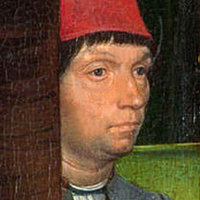
The most celebrated and influential northern painter in the earlier 15th century, responsible for developing a style of oil painting capable of magnificent detail and effects of light. His major work, the altarpiece in Ghent Cathedral, is recorded to have been begun by his perhaps even greater brother Hubert. He was a renowned portraitist, including the enigmatic Arnolfini Marriage in London, and the supposed self-portrait seen here.
|
 |
Guillaume Dufay, 1397–1474. Franco-Flemish composer.
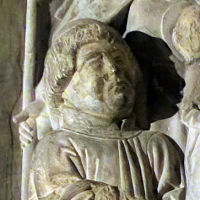
Dufay (also spelled Du Fay and other variants) was born near Brussels. Writing in most genres and traveling widely, he was regarded as the leading composer of his time, composing for example a motet for the dedication of Brunelleschi's dome of Florence Cathedral. [The portait comes from his tomb.]
|
 |
Petrus Christus, 1410–76. Netherlandish painter, active in Bruges.
Whether or not he actually studied with Jan van Eyck, he became one of his most distinguished followers, and the leading painter in Bruges after his death. [The portrait is by him, but almost certainly not of him.]
|
 |
Hans Memling, 1430–94. German-Flemish painter.
Based in Bruges, and probably a pupil of Rogier van der Weyden, he developed a sweeter more balanced version of his style which brought him great success. Also spelled "Memlinc."
|
 |
Hugo van der Goes, 1435–1482. Netherlandish painter.
The major figure of the second half of the 15th century in the Netherlands, he is known for his psychological observation and the richness of his backgrounds, as in the Portinari Altarpiece which introduced his style to Florence. [Identificaton of this as a self-portrait is conjectural.]
|
 |
Josquin des Prez, 1440–1521. Franco-Flemish composer.
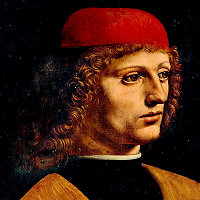
Josquin is considered one of the leading composers in the High Renaissance, and not just in the Franco-Flemish school. Almost all his works are vocal, mostly sacred. He is credited with breaking away from the tradition of long melismatic lines, writing instead in short imitative phrases that are closely expressive of the text. [This portrait of a musician by Leonardo da Vinci has not definitely been identified as Josquin, although both were in Milan at the same time.]
|
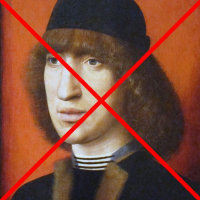 |
Hayne van Ghizeghem, 1445–97. Flemish composer.
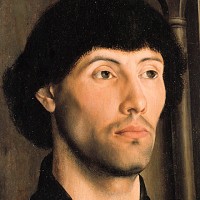
Very little is known of his life, other than that he was born in Flanders and served in the court of Charles the Bold. On the other hand, his secular Chansons such as "Allez regets" were so well known that they were transcribed (and later reprinted) several dozen times. [The roughly contemporary portrait is a placeholder only.]
|
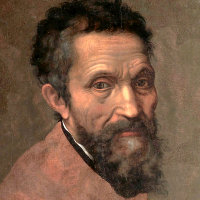 |
Michelangelo Buonarroti, 1475–1564. Florentine sculptor, architect, painter, and poet.
A towering universal genius, his work virtually defines the Italian High Renaissance. He made his name primarily as a sculptor in his native Florence, though he worked elsewhere as well. His most famous works, however, are in Rome: the ceiling of the Sistine Chapel (1508–12) and his work from 1546 as leading architect of the Basilica of St. Peters, one of a succession of masters who brought the building to its present form.
|
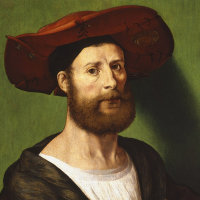 |
Jan Gossaert, 1478–1532. Netherlandish painter.
Gossaert, also known as "Mabuse," visited Italy in 1508–9, and thereafter combined Italianate subjects (including those from classical myth) with a Netherlandish precision of detail.
|
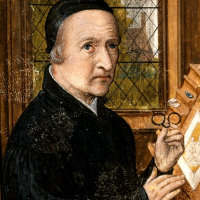 |
Simon Bening, 1483–1561. Netherlandish book illuminator.
Working in Bruges, he represents the very end of the Northern European tradition of illustrating religious texts such as Books of Hours with detailed reference to the lives of ordinary people of the time.
|
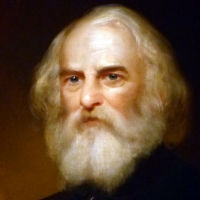 |
Henry Wadsworth Longfellow, 1807–82. American poet.
Longfellow was born in Maine, and taught at Bowdoin College and later at Harvard. His American themes and stirring diction made him the most popular poet of his day and earned him a reputation abroad. His Song of Hiawatha (1855) and similar poems employed the form of the Finnish Kalevala to create a similar Native American myth.
|
 |
Erich Korngold, 1897–1957. German composer.
Korngold was born in Brno, then a German enclave. He showed great promise as a child pianist and soon also a composer, absorbing the richness of late Romanticism which was then at his height. He reached the peak of his fame in the 1920s, when opera houses fought to premiere his opera Die tote Stadt. Invited to Hollywood in 1934 by Max Reinhardt, he both escaped the Nazis (he was a Jew) and began a new career as a film composer, finding that his style worked perfectly for the swashbuckling romances then in fashion.
|


