3. Florence: Cradle of the Renaissance.
Few would argue with the subtitle. The 1400s (quattrocento) in Florence saw the rise of artists such as Masaccio,
Ghiberti, Brunelleschi, Botticelli, and later in the century Leonardo and Michelangelo, who would combine the spirit of new
discovery with a scientific rigor based on classical humanism. To a large part, they were bankrolled by the Medici, that
ambitious and at times unscrupulous family that became the bankers of Europe and underwriters of the Papacy. For them,
manifestations of art and projections of power became one and the same, and their legacy is everywhere, not least in
the celebrated Uffizi Gallery, built upon the 1743 bequest of the Medici collection to the state.
Yet walking around Florence today, one is surrounded by the medieval period as much as by the quattrocento. There was an earlier
renaissance around 1300 that produced Dante, Giotto, and Petrarch, and many Florentine buildings are older still. Several of them became
frames for public sculpture, and though much of it has been moved indoors to museums, much remains in place. The unique combination
of art and setting made Florence a required stop on the Grand Tour for centuries, giving rise to a rich range of representation by
outsiders, some of which we shall sample towards the end of the class. rb.
The script, videos, and images will be posted immediately after class.
Here are brief bios of the composers and writers considered in the class, listed in order of birth.
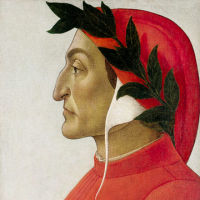 |
Dante Alighieri, 1265–1321. Florentine poet.
Dante is so highly regarded as the author of the Divina Commedia and founder of Italian poetry, that any capsule biography here would be superfluous. There are at least five operas based on his work: Puccini's Gianni Schicchi, plus versions of Francesca di Rimini by Mercadante, Rachmaninoff, Ambroise Thomas, and Zandonai. The portrait by Botticelli is posthumous.
|
 |
Giotto di Bondone, 1270–1337. Florentine painter.
The outstanding artist of his era, Giotto, much like his contemporary Dante, blazed the path on which art would travel over the succeeding centuries (although it was over 100 years before he had any real followers). He is known especially for his fresco cycles in Florence, Padua, and Assisi. The portrait is speculative.
|
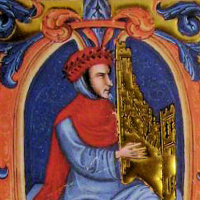 |
Francesco Landini, 1325–97. Florentine composer.
The leading Italian composer of the later 14th century, he was organist at various Florentine churches, and most probably a close friend of the poet Petrarch. Many of his secular songs have survived, but none of his sacred music.
|
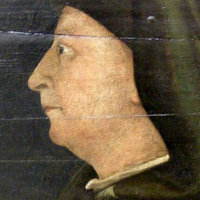 |
Filippo Brunelleschi, 1377–1446. Florentine architect.
One of the founding fathers of the Renaissance, he came to prominence as a sculptor in the competition for the Florence Baptistery doors, eventually won by Ghiberti. But it was as an architect that he made his biggest impression on the city, with the churches of San Lorenzo and Santo Spirito, and his crowning achievement, the dome of Florence Cathedral.
|
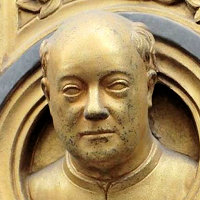 |
Lorenzo Ghiberti, 1378–1455. Florentine sculptor.
He came to prominence in 1401, defeating Brunelleschi for the design of doors for the Florence Baptistery. He followed these up in 1437 with the design of an even grander set of doors, dubbed by Michelangelo the "Gates of Paradise."
|
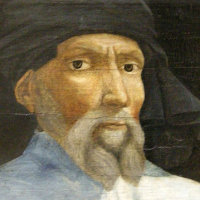 |
Donatello (Donato di Niccolo), 1386–1466. Florentine sculptor.
The outstanding sculptor of his day, Donatello ranks with Brunelleschi in architecture and Masaccio in painting as a standard-bearer of the Renaissance. He studied under Ghiberti, but soon struck out on his own, producing an immense variety of work over a long career, showing technical daring, psychological insight, and a characteristic grace.
|
 |
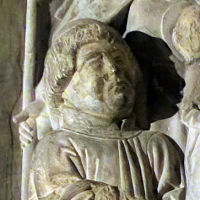
Guido di Piero (Fra Angelico), 1395–1455. Florentine painter.
He is first recorded as a painter in 1417, and by 1423 had joined the Dominican Order in Fiesole, where he remained all his life, becoming prior in 1450. Although not an innovator like Masaccio, he is noted for the purity of his style, which set the tone for Florentine art of the mid-quattrocento (1400s). He took the name Fra Giovanni, but it is as Fra Angelico (Angelic Brother), and later Beato Angelico, that he is recorded.
|
 |
Guillaume Dufay, 1397–1474. Franco-Flemish composer.
Dufay (also spelled Du Fay and other variants) was born near Brussels. Writing in most genres and traveling widely, he was regarded as the leading composer of his time, composing for example a motet for the dedication of Brunelleschi's dome of Florence Cathedral. [The portait comes from his tomb.]
|
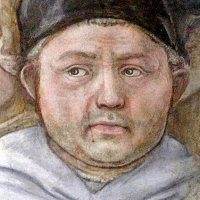 |
Fra Filippo Lippi, 1406–69. Florentine painter.
A reluctant friar, Lippi was released from his vows after an affair with a nun (that produced their painter son Filippino), but continued to sign himself "Brother Lippi." His exquisite drawing, pale color harmonies, and formal innovations set the standard for mid-quattrocento Florentine painting, as seen for example in the work of Botticelli and his son.
|
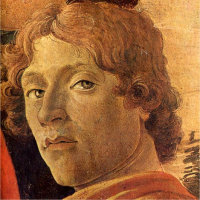 |
Sandro Botticelli, 1445–1510. Italian painter.
Botticelli's work was neglected for centuries, but he is now acknowledged as the leading Florentine painter of the later quattrocento. Although he produced numerous religious paintings, he is best known for two large mythological works: Primavera (c.1480) and The Birth of Venus (c.1485).
|
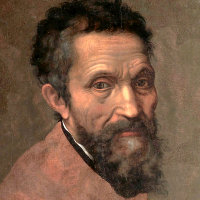 |
Michelangelo Buonarroti, 1475–1564. Florentine sculptor, architect, painter, and poet.
A towering universal genius, his work virtually defines the Italian High Renaissance. He made his name primarily as a sculptor in his native Florence, though he worked elsewhere as well. His most famous works, however, are in Rome: the ceiling of the Sistine Chapel (1508–12) and his work from 1546 as leading architect of the Basilica of St. Peters, one of a succession of masters who brought the building to its present form.
|
 |
Benvenuto Cellini, 1500–71. Italian goldsmith and sculptor .
Born in Florence, Cellini showed early promise as a musician, but was apprenticed by his father to a goldsmith. He eventually became the most celebrated goldsmith of his age, but worked on the large scale also, as in the Perseus in Florence. His frank and racy Autobiography (1563), which chronicles a highly eventful life, was hailed by a contemporary as "the most delightful ever written."
|
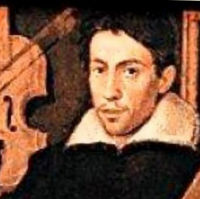 |
Giulio Caccini, 1548–1616. Italian composer.
Born and trained in Rome, Caccini was brought to Florence by Francesco de' Medici, as singer, choirmaster, and composer. He was one of the members of the Camerata gathered around Count Bardi, and as such was influential in the creation of opera and development of the new seconda prattica style.
|
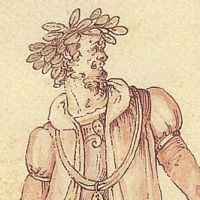 |
Jacopo Peri, 1561–1633. Italian composer.
Peri was a leading member of the Florentine Camerata in the late 16th century. His Dafne (1597, now lost) is regarded as the first opera. The picture shows him in the role of Arion.
|
 |
Elizabeth Barrett Browning, 1806–61. English poet.
Elizabeth Barrett had established herself as a poet well before she met Robert Browning, whom she eventually married at the age of 40, and was disinherited by her father for doing so. Her sequence of love-letters to Browning, Sonnets from the Portuguese (1850) have been widely influential.
|
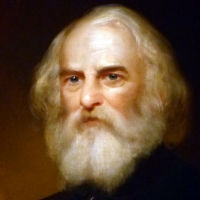 |
Henry Wadsworth Longfellow, 1807–82. American poet.
Longfellow was born in Maine, and taught at Bowdoin College and later at Harvard. His American themes and stirring diction made him the most popular poet of his day and earned him a reputation abroad. His Song of Hiawatha (1855) and similar poems employed the form of the Finnish Kalevala to create a similar Native American myth.
|
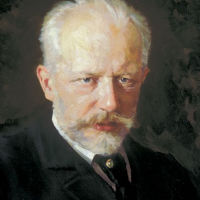 |
Pyotr Ilyich Tchaikovsky, 1840–93. Russian composer.
Tchaikovsky was the first Russian composer to gain an international reputation, in part because his Russian voice was allied to a thorough training in Western parctice. His symphonies, tone-poems, and ballets have become staples of their repertoire, but his dozen operas are less well-known, except for Eugene Onegin (1879) and The Queen of Spades (1890), both based on texts by Pushkin.
|
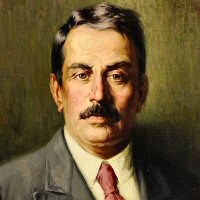 |
Giacomo Puccini, 1858–1924. Italian composer.
Puccini took up the mantle of Verdi as the dominant opera composer of the late 19th century, and developed an international popularity that is unrivaled to this day. His principal works include: Manon Lescaut (1893), La bohème (1896), Tosca (1900), Madama Butterfly (1904), and the unfinished Turandot (1926).
|
 |
Thomas J. Price, 1980– . British sculptor.
Trained in London, Price has made a fairly recent reputation for his over-life-size sculptures of ordinary black women, placed in environments in ways that provoke throught about the activities or other art nearby.
|


