Class 4: Venice: City of Contrasts.
The first part of the class will consider a few of Venice's many contrasts: between land and water, light and darkness, luxury and
dilapidation, commerce and romance. It is unique in its physical setting, unique in history, unique in culture. It was Europe’s gateway
to the East and a premium supplier of luxury goods. It developed unique traditions of art and music, opera, and street theater. Its
particular argot has left traces in most other languages around the world. Although nominally religious, it kept largely free from
Counter-Reformation repression, and became known as the city where everything was possible.
Succeeding sections will give a brief overview of sspecific topics: the history of the city over more than a milennium; iconic paintings
from the High Renaissance in its Accademia Gallery; early baroque music written specifically for its churches; Venetian masks, luxury, and
high-end fashion; and the way the city has been represented by artists, writers, and filmmakers from abroad. rb.
The script, videos, and images will be posted immediately after class.
Here are brief bios of the composers and writers considered in the class, listed in order of birth.
 |
Giovanni Bellini, 1435–1516. Venetian painter.
One of a family of artists, he more than anyone was responsible for developing the characteristic Venetian style of painting in layers of oils, no doubt learned from the Flemish masters. This gives his pictures their extraordinary light, whether portraits or religious subjects.
|
 |
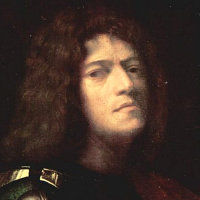
Vittore Carpaccio, 1465–1526. Venetian painter.
Born, trained, and working in Venice his whole life, Carpaccio remains one of the most Venetian of painters, especially in urban scenes that provide a detailed image of the city in his time. He is rather conservative, however, and never attempted the sensuous beauty of late Bellini or early Titian. [The portrait is by him, but almost certainly not of him.]
|
 |
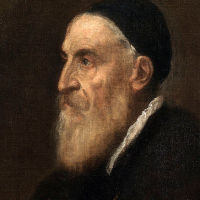
Giorgione (Giorgio da Castelfranco), 1477–1510. Venetian painter.
Almost nothing is known of his life, and the catalogue of his undisputed works is very small, his fame and influence are quite disproportionate to the size of his output. He was an exquisite colorist, the first to specialize in cabinet paintings for private patrons rather than religious commissions, and the first painter to subordinate subject matter to the evocation of mood.
|
 |
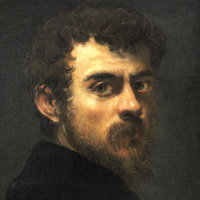
Tiziano Vecellio (Titian), 1485–1576. Venetian painter.
Arguably the greatest Venetian painter of the High Renaissance, he produced works in just about every genre over an exceptionally long career. Probably his greatest influence was in his handling of paint and use of color, which became a starting point for Rubens and others in the next century.
|
 |
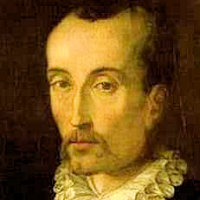
Jacopo Tintoretto, 1518–94. Venetian painter.
With Titian, Tintoretto is the great Venetian master of the earlier 16th century, excelling in both religious and secular subjects. His paintings are generally darker than Titian's and rougher in touch, but he yields nothing in vigor or the scope of his imagination.
|
 |
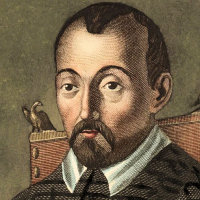
Giaches de Wert, 1535–96. Franco-Flemish composer.
Born in Flanders, Wert went to Italy as a choirboy and remained there the rest of his life, working mainly for the Gonzaga court in Mantua and the Este court in Ferrara. He played an important part in the development of the madrigal in Italy in the generation befoe Monteverdi.
|
 |
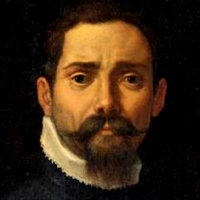
Giovanni Battista Guarini, 1538–1612. Italian poet.
"No poet played a larger role in the flowering of the madrigal in the late Renaissance and early Baroque eras than Guarini. His poems were set more often by madrigal composers than the work of any other." [Wikipedia]
|
 |
Giovanni Gabrieli, 1557–1612. Italian composer.
Third in a line of succession to Adrien Willaert and his uncle Andrea Gabrieli as organist of Saint Mark's in Venice, he is famous for the spatial effect of his polychoral compositions, using mixed groups of instruments and voices calling to one another antiphonally between the various balconies of the church.
|
 |
Claudio Monteverdi, 1567–1643. Italian composer.
The towering genius of the first half of the 17th century, and a founding father of opera. Unfortunately, only three of his dozen operas survive: La favola di Orfeo (The Story of Orpheus), written for Mantua in 1607 and the earliest opera to remain in the general repertoire, and The Return of Ulysses and The Coronation of Poppea, both written for Venice at the end of his life.
|
 |
Pier Francesco Cavalli, 1602–76. Italian composer.
The leading opera composer after Monteverdi, his works dominated the Venetian stage in the mid 1600s, and frequently addressed mythological subjects, such as his La Calisto (1651).
|
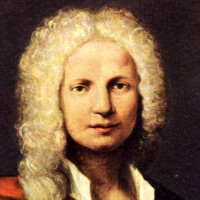 |
Antonio Vivaldi, 1678–1841. Italian composer.
Vivaldi, who was ordained as a priest, but lived a largely secular life, was an amazingly prolific composer of music in most genres, including opera, oratorio, and the instrumental concerti on which his later fame mainly rests.
|
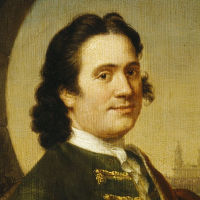 |
Canaletto, 1697–1768. Venetian painter.
Giovanni Antonio Canal was the son of a painter, so his nickname "Canaletto" means simply "Canal Jr." It has nothing to do with the literal canals of Venice, although these figure prominently in his numerous Vedute or views of the city. These sold extremely well to foreign visitors, especially those from Britain. As a result of these connections, Canaletto lived in England from 1746 to 1755, painting similar views in London and elsewhere.
|
 |
Carlo Goldoni, 1707–93. Venetian playwright.
Although Goldoni was trained as a lawyer, his chief interest was the stage, and he led a long life both managing theaters and writing for them. Comedies like The Servant of Two Masters (1745) quickly became classics, uniting the Italian traditions of commedia dell'arte with a well-constructed plot, and written (as opposed to improvised) dialog that often includes Venetian dialect. He also wrote tragedies and libretti for composers like Galuppi, Haydn, and even Mozart, but it is for his spoken comedies that he is best remembered.
|
 |
Wolfgang Amadeus Mozart, 1756–91. Austrian composer.
A child prodigy as both performer and composer, Mozart produced an extraordinary body of work in all genres over a relatively short life. He wrote the greatest of his many operas after moving to Vienna: three collaborations with Lorenzo da Ponte—The Marriage of Figaro (1786), Don Giovanni (1787), and Così fan tutte (1790)—framed by two German Singspiels: The Abduction from the Seraglio (1782) and The Magic Flute (1791).
|
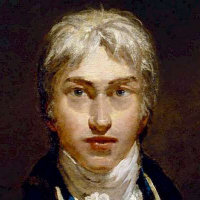 |
Joseph Mallord William Turner, 1775–1851. English painter.
Rivaled only by Constable, Turner was the dominant British landscape painter of the first half of the 19th century, he started his career with topographical views intended for engraving, and ended with works whose subjects were dissolved in veils of paint and light. His Fighting Temeraire (1838) was recently voted the Greatest British Picture in a BBC poll.
|
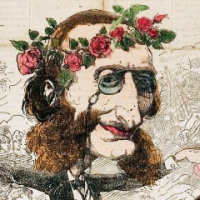 |
Jacques Offenbach, 1819–80. German-French composer.
The son of a cantor, Offenbach took the name of the German town near Cologne in which he was born. After studying briefly at the Paris Conservatoire and establishing a career as cello soloist and conductor, he began to write operettas, composing over 90 in the course of a long and wildly successful career. He is also known for his unfinished grand opera The Tales of Hoffmann.
|
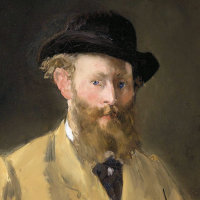 |
Édouard Manet, 1832–83. French painter.
Manet is arguably the greatest French painter in the third quarter of the 19th century. Though primarily a realist, he was influenced by older artists such as Titian and Velasquez. He was admired by the young Impressionists, became friends with Monet, and produced a number of works in their style, but he never exhibited with them, preferring to retain his own status in the official Salons.
|
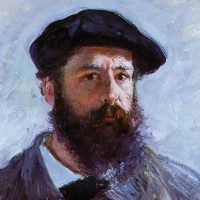 |
Claude Monet, 1840–1926. French painter.
The central figure in Impressionism (it was his Impression: Sunrise of 1872 that gave the movement its name), he intensified its focus more than any other artist, continuing well into the next century to produce series of paintings showing minute variations in the light and color in basically the same scene. Cézanne famously said of him, "Monet is nothing but an eye—but my God, what an eye!"
|
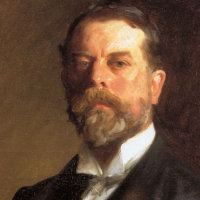 |
John Singer Sargent, 1856–1925. American painter.
Sargent was born in Florence, the son of wealthy cultured parents, and much of his career was spent in Europe, although his rising fame as the preeminent society portraitist of his day also took him back to America. He is said to have hated portraiture, though, and diversified into landscapes and watercolors for his own satisfaction.
|
 |
Thomas Mann, 1875–1955. German novelist.
Winner of the 1929 Nobel prize in literature, Mann's best-known works date from before he fled from Germany in 1933: these include the novels Budenbrooks and The Magic Mountain and the 1912 novella Death in Venice. Eventually settling in America, he continued to write until his death.
|
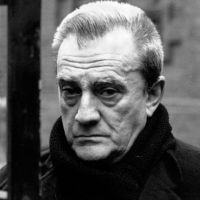 |
Luchino Visconti, 1906–76. Italian film and opera director.
Though born into a Milanese aristocratic family, Visconti became a Communist, and his earlier films depict working-class life with brutal realism. In 1963, with his filming of Lampedusa's The Leopard, his style changed totally, and his last works are noted for their opulent depictions of decadence. He was also one of the greatest opera directors of his time.
|
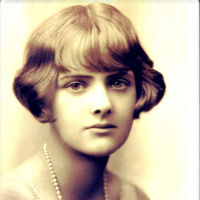 |
Daphne du Maurier, 1907–89. British writer.
The daughter of a prominent actor-manager, and granddaughter of a Punch cartoonist, du Maurier had early access to people who were useful in her career. Her 1939 novel Rebecca was her most successful work, forming the basis for the iconic film by Alfred Hitchcock (who also adapted her later story The Birds ). She lived in relative seculsion in a house in Cornwall, very similar to Manderley in that novel. Although she never used the titles, she became Dame Daphne in her own right and Lady Browning through her marriage to WW2 general Frederick "Boy" Browning.
|
 |
Joseph Losey, 1909–84. American filmmaker.
Born in Wisconsin, Losey studied in Germany with Bertolt Brecht. Blacklisted by Hollywood in the 1950s, he moved to England, and made the rest of his films there, including three with screenplays by Harold Pinter: The Servant (1963), Accident (1967), and The Go-Between (1971). He also directed in the theater and opera house, the latter following his success filming Mozart's Don Giovanni in 1979.
|
 |
Nicholas Roeg, 1928–2018. British filmmaker.
Roeg (pronounced "Rohg") worked his way up in the film industry from clapper-boy to cameraman, and thence to director. His films such as Walkabout (1971) and Don't Look Now (1973) are noted for their radical intercutting of disparate scenes and non-linear narrative, making him an icon with film critics, though not always a success with the public.
|
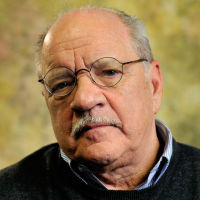 |
Paul Schrader, 1946– . American filmmaker.
Schrader trained as a Calvinist minister, but entered the film industry instead. He had a long collaboration with director Martin Scorcese, writing the scripts for Taxi Driver (1976), Raging Bull (1980), and others. His directorial credits include American Gigolo (1980) and The Comfort of Strangers (1990), which had a screenplay by Harold Pinter from the novel by Ian McEwan and was filmed in Venice.
|


