Class 5: Rome: Projection of Power.
Holiness, Hegemony, Hedonism: three utterly Roman qualities. Stylistically, the city is a palimpsest, the artifacts of one
century written over the half-erased traces of its predecessors. Rome was the base for one of the most successful Empires in
history. Overlapping with this, it established itself as a holy city, the seat of the Catholic Church, with congregants
spread all over the world. All these have left an impact on the Rome we visit today.
But there is one quality that spans styles and periods, making little distinction between secular and sacred. Almost
everything we see in Rome is a Projection of Power: power of the state, power of the church, power of the various families
that have ruled the city and passed the papacy between them. It makes an unusual way to look at the city, but I hope a valid one.
rb.
The script, videos, and images will be posted immediately after class.
Here are brief bios of the composers and writers considered in the class, listed in order of birth. Note that the
list does not include some people who I suspect will not come up in other classes.
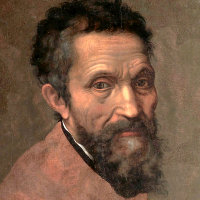 |
Michelangelo Buonarroti, 1475–1564. Florentine sculptor, architect, painter, and poet.
A towering universal genius, his work virtually defines the Italian High Renaissance. He made his name primarily as a sculptor in his native Florence, though he worked elsewhere as well. His most famous works, however, are in Rome: the ceiling of the Sistine Chapel (1508–12) and his work from 1546 as leading architect of the Basilica of St. Peters, one of a succession of masters who brought the building to its present form.
|
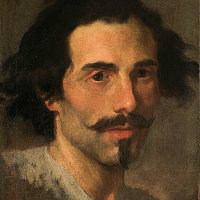 |
Gianlorenzo Bernini, 1598–1680. Italian sculptor and architect.
He is to the Italian Baroque what Michelangelo was to the Renaissance, the supreme master of many arts. The sense of movement and drama in his sculpture carries through into his architecture and even his town planning, such as the piazza before St. Peter's.
|
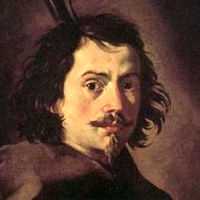 |
Francesco Borromini, 1599–1677. Italian architect.
Born Francesco Castelli in Italian Switzerland, he began to use his mother's family name when he came to Rome and emerged as the chief architectural rival to Gianlorenzo Bernini. Compared to him, though, he was a more temperamental personality, which may be reflected in the strikingly original distortions of classical motifs in many of his designs.
|
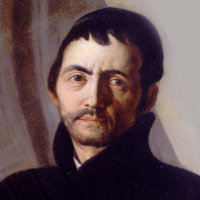 |
Fra Andrea Pozzo, 1642–1709. Italian painter.
A Jesuit lay brother, he is most famous for his masterpiece, the ceiling fresco in Sant'Ignazio in Rome, perhaps the most stupendous feat of illusionistic painting ever accomplished. He also worked in several other cities, including Vienna, and published a treatise on architectural painting which was widely influential.
|
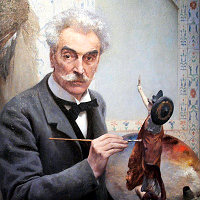 |
Jean-Léon Gérôme, 1824–1904. French painter.
A leading academic painter of the mid-century, his works have been described by one critic (Lorenz Eitner) as "carefully plotted picture-plays, graced with sex, spiced with gore, and polished into waxwork lifelikeness by a technique that his admirers took for realism." He was much favored by American buyers including William Walters for his collection in Baltimore.
|
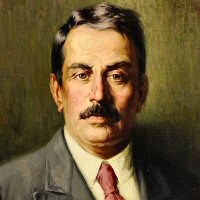 |
Giacomo Puccini, 1858–1924. Italian composer.
Puccini took up the mantle of Verdi as the dominant opera composer of the late 19th century, and developed an international popularity that is unrivaled to this day. His principal works include: Manon Lescaut (1893), La bohème (1896), Tosca (1900), Madama Butterfly (1904), and the unfinished Turandot (1926).
|
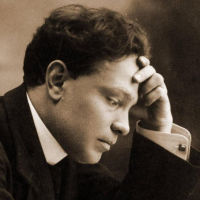 |
Ottorino Respighi, 1879–1926. Italian composer.
Wikipedia writes: "His compositions range over operas, ballets, orchestral suites, choral songs, chamber music, and transcriptions of Italian compositions of the 16th–18th centuries, but his best known and most performed works are his three orchestral tone poems which brought him international fame: Fountains of Rome (1916), Pines of Rome (1924), and Roman Festivals (1928)."
|
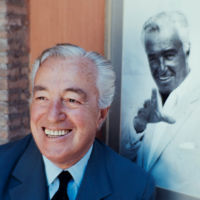 |
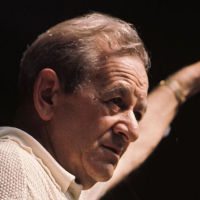
Vittorio de Sica, 1901–74. Italian filmmaker.
De Sica began his career as an actor, appearing all over Italy and co-founding his own company in 1933. He was already working in film in the summer months, and in the turbulent years after the War emerged as one of the leaders of the Neo-Realist movement. A 1952 poll in Sight and Sound ranked his Bicycle Thieves (1948) as the greatest film ever made. Both this and The Garden of the Finzi-Continis (1970) won Academy Awards.
|
 |
William Wyler, 1902–81. American filmmaker.
Born in Alsace (then part of Germany), Willi Wyler emigrated to the US at the age of 19. He began working almost immediately in minor capacities for Universal Pictures (founded by his mother's cousin). He got his first directing assignment at 23. But this was no case of nepotism; he won the Oscar three times, and went on to direct a string of successes such as Wuthering Heights (1939), Roman Holiday (1953), andBen-Hur (1959). Known as a technical perfectionist, he nonetheless had a gift for bringing the best out of his actors.
|
 |
Tennessee Williams, 1911–83. American playwright.
His plays, including The Glass Menagerie (1944), A Streetcar Named Desire (1947), and Cat on a Hot Tin Roof (1955), established Williams as one of the leading American playwrights of the 20th century, arguably the most edgy and sexually charges. Elia Kazan, who filmed many of his works, said "Everything in his life is in his plays, and everything in his plays is in his life." Unfortunately his work declined in later years, due to alcoholism and bouts of depression.
|
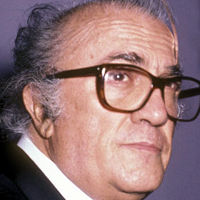 |
Federico Fellini, 1920–93. Italian film director.
After a brief stint as a law student to please his parents, Fellini broke out as a cartoonist, writer, and later filmmaker. Beginning in the neo-realist style with works like La strada (1954), he gradually moved towards the more fantastic treatment that defined his style, in films like La dolce vita (1960), 8½ (1963), and Amarcord (1973). He is commonly listed among the greatest directors ever.
|


