Class 6: Vienna: Music in the Air.
For two and a half centuries, Vienna has been a music capital. The foundations were laid by generations of music-loving
Habsburgs, who attracted composers and performers from all over Europe. It is also a city that has perpetuated itself
in music, through folksong, café music, and the omnipresent waltz. You do not need to buy a ticket to go and hear it;
in Vienna, music is in the air. In the first hour, we’ll drink some of it in.
Vienna is also the product of both its two-millennium history and its geographical location, at the center of compass
points facing East, South, West, and North. In the second hour, we’ll consider the consequences of these factors in
Viennese art and architecture, before taking a brief look at the city in two specific periods: the years of Mozart
leading towards 1800, and those of Freud, following on from 1900. rb.
The script, videos, and images will be posted immediately after class.
Here are brief bios of the composers and writers considered in the class, listed in order of birth. Note that the
list does not include some people who I suspect will not come up in other classes.
 |
Wolfgang Amadeus Mozart, 1756–91. Austrian composer.
A child prodigy as both performer and composer, Mozart produced an extraordinary body of work in all genres over a relatively short life. He wrote the greatest of his many operas after moving to Vienna: three collaborations with Lorenzo da Ponte—The Marriage of Figaro (1786), Don Giovanni (1787), and Così fan tutte (1790)—framed by two German Singspiels: The Abduction from the Seraglio (1782) and The Magic Flute (1791).
|
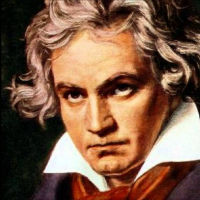 |
Ludwig van Beethoven, 1770–1827. German composer, working primarily in Vienna.
The dominant composer of his time, Beethoven wrote 9 symphonies, 16 string quartets, 32 piano sonatas, and one opera, Fidelio, which he labored on in several versions between 1805 and 1814. From about 1800 onwards, increasing deafness gradually put an end to his performing career, although he wrote some of his finest works when totally deaf. He is one of the first composers to exhibit a distinct late style.
|
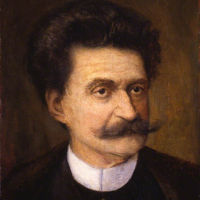 |
Johann Strauss II, 1825—99. Austrian composer.
His musician father did not want his son to follow in his foosteps, so he worked as a bank clerk while studying privately. His first professional appearances were as a conductor of his father's waltzes, to which he added his own and eventually became hailed as the Waltz King of Vienna. His Die Fledermaus (1874) virtually defines the genre of Viennese operetta.
|
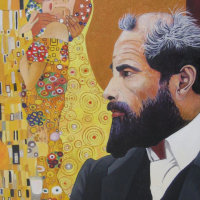 |
Gustav Klimt, 1862–1918. Austrian painter.
Klimt was the foremost painter of the Vienna Seccession at the turn of the century. He specialized in female subjects, some taken from myth, painted in a highly-patterned Symbolist style, erotic and richly colored, often with the addition of gold leaf. His Danaë of 1907 is a prime example.
|
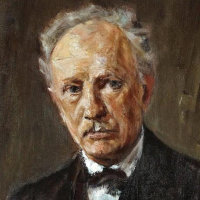 |
Richard Strauss, 1864–1949. German composer.
You might say that Strauss had two careers: as an orchestral composer, and as an opera one. His tone poems in the 1890s such as Don Juan and Till Eulenspiegel brought him immediate fame, but he wrote his last big orchestral work in 1915. Meanwhile his operas Salome (1905) and Elektra (1909) continued his radical Expressionism, but with Der Rosenkavalier (1911), he began a stylistic retreat that continued until his last opera, Capriccio, in 1942.
|
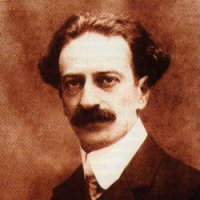 |
Oscar Straus, 1870–1954. Austrian composer.
Dropping the last letter of his family name, Strauss, to avoid association with the waltz family, he nonetheless worked in a similar vein, composing operettas and other light music. He is best known for the operettas Ein Waltzertraum (1907) and The Chocolate Soldier (1908). Jewish by birth, he escaped to Hollywood during the War, but returned to Vienna after it.
|
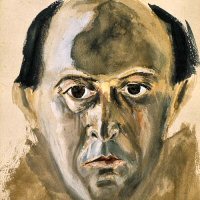 |
Arnold Schoenberg, 1874–1951. Austrian composer and theorist.
Schoenberg is most famous in the history of music as the developer first of atonal music and then of the principle of musical organization known as Serialism. He wrote three shorter operas, but his masterpiece is Moses und Aron. Although he conceived it in three acts, Schoenberg had only finished two when he emigrated to America in 1934, and it is this version that is usually performed. [Schoenberg was also a painter; this is a self-portrait.]
|
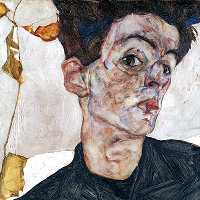 |
Egon Schiele, 1890–1918. Austrian painter.
A follower of Gustav Klimt, who encouraged him throughout his career, Schiele early developed a highly energetic style of nervous lines and angled forms. Despite his tendency to depict his subjects as though gesticulating, he had some success as a portraitist, but is now better known for his frank depictions of sexual subjects.
|
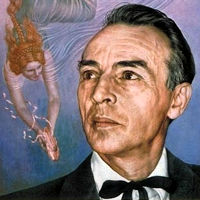 |
George Balanchine, 1904–83. Georgian-American choreographer.
After work with Diaghilev's Ballets Russes, including the pioneering neo-classical Apollon musagète (1928, with Stravinsky) and The Prodigal Son (1929, with Prokofiev), he moved to America, where he eventually co-founded the New York City Ballet, remaining its artistic director for 35 years. One of the most influential choreographers of the century, he is especially noted for his abstract works with minimal decor but the greatest musicality.
|
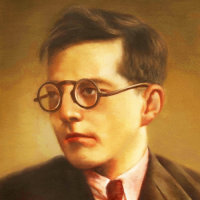 |
Dmitri Shostakovich, 1906–75. Russian composer.
A child prodigy, Shostakovich entered the St. Petersburg Conservatory at 13. His first symphony, composed while still a student, won him national accalim, and he went on to write 14 other symphonies, 15 string quartets, and numerous other works, including ballet and film music. His 1934 opera Lady Macbeth of Mtensk, although initially successful, fell afoul of Stalin, forcing the composer to take unusual measures to save his career, and indeed his life.
|
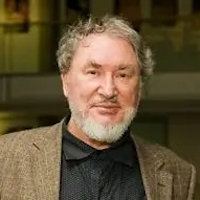 |
HK Gruber, 1943– . Austrian composer.
Heinz Karl Gruber, who works only under his initials, is a double-bassist, conductor, and chansonnier as well as a composer. Highly eclectic, one ciric (Paul Driver) has called him "a sentient (and downright accomplished) composer who keeps responding to whatever musical stimulus, be it highbrow or lowbrow, 12-tone or 7-tone, bitter or sweet, that comes his way." He came to the fore in 1978 with Frankenstein!!, a 'pan-demonium' for chansonnier and orchestra.
|
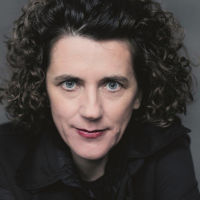 |
Olga Neuwirth, 1968– . Austrian composer.
Born in Graz, Neuwirth is the daughter of a pianist and sister of a sculptor. She has pursued both music and visual art herself, studying first in San Francisco and later in Vienna, where she is now a professor. In addition to instrumental music, she has written eight stage works, including Lost Highway (2003), after the film by David Lynch, three collaborations with Nobel prizewinner Elfriede Jelinek, and Orlando (2019), based on Virginia Woolf. The latter was the first opera ever commissioned by the Vienna Staatsoper from a female composer. Like most of her work, it also explores social activist themes.
|


