Class 7: Amsterdam: Reflections in Water.
In layout, architecture, and art, Amsterdam is the perfect preservation of a 17th-century city, and uniquely of the lives lived
there. No other school strives with such accuracy to portray the place, its inhabitants, their outer habits, and their civic and
moral principles as Dutch artists did for the newly-prosperous middle class at the height of the Golden Age. The first hour of the
class will explore how Amsterdam reached this point, looking first at the physical structure of the city, and then at its people,
both in groups and as individuals.
But Dutch prosperity declined in the latter part of the century. Amsterdam reached a low point under Napoleon, experienced a second
Golden Age in the later 19th century, then hit an even lower point under Hitler. Today, though, it is a vibrant modern city, a little
edgy, celebrated for its tolerance, treasuring the surprising and offbeat, and a center for artistic creativity of all kinds. rb.
The script, videos, and images will be posted immediately after class.
Q AND A
Who are the people in At the Linen Closet by Pieter de Hooch?
Because I wanted to show the Dutch representation of servants, I had assumed that the people in the painting were a mistress and
servant. But I could not figure why the younger woman was so richly dressed. It is true that the older one seems more plain, but
she is wearing a fur-lined jacket, and her hair covering is very much like those of the board members in the Hals Regentesses,
making her presumably a widow of means and station. I could find nothing definitive, but the best I can work out is that this is a
mother helping her daughter sort out the laundry for the week (or day?), thus conveying a moral that is the counterpoint to that in
the Jan Steen: that good parents pass on the habits of cleanliness and order to their children, and that the neatness in the
household reflects the balance of a god-fearing ordered life.
VIDEO LINKS
Almost all the clips played in class are available on YouTube. Several are longer than I was able to play, although I have
cued them to the point we started; scroll back to see the whole thing. The major exception is the opening sequence from the
Girl With a Pearl Earring movie; I do, however, give a link to the trailer, and to a playlist containting many other
clips. Items we did see, whole or in part, are *asterisked.
I made several additions. In the first section, a couple of videos on the growth of Amsterdam, one
told through maps, the other by animations of famous paintings. In the second section, I added a
trailer from the Peter Greenaway film on The Night Watch, extra SmartHistory discussions of several works we glanced at
more briefly, and a video on Jan Steen. In the third part, I include the complete performance of the
St. Matthew Passion from which the clip we saw was taken, plus a much lighter and leaner complete performance by a group
founded precisely as a riposte to the large-scale interpretations at the Concertgebouw; Amsterdam is a city that takes its early
music very seriously. And the final section includes several other clips from the Nederlands Dans
Theater, ranging from the gorgeously elegant (Kylian) to the radical (Pite), and three more clips of the Haydn Mass at the Opera,
although the section we actually saw is not available. I strongly recommend the last of these, "Qui tollis," as it is a complete
number, beautifully sung to beautiful music, and with beautiful if enigmatic staging; I did not include it in the class only
because I have shown it before, and also wanted something rather more edgy. rb.
| |
|
|
|
|
|
| IMAGES |
The thumbnails below cover the slides shown in class, plus the
individual images in some of the montages. Click the thumbnail to see a larger image.
Click on the right
or left of the larger picture to go forward or back, or outside it to close. |
 | |
 | |
 | |
 | |
 | |
 | |
 | |
 | |
 | |
 | |
 | |
 | |
 | |
 | |
 | |
 | |
 | |
 | |
 | |
 | |
 | |
 | |
 | |
 | |
 | |
 | |
 | |
 | |
 | |
 | |
 | |
 | |
 | |
 | |
 | |
 | |
 | |
 | |
 | |
Here are brief bios of the composers and writers considered in the class, listed in order of birth ("bdnk" stands for "birthdate not known").
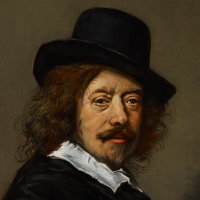 |
Frans Hals, 1582–1666. Dutch painter.
Though born in Antwerp, he moved to Haarlem with his parents and spent the rest of his life there. 24 years older than Rembrandt, he was the first great master of the Dutch Golden Age and its leading portraitist. His style is remarkable for the effects he could achieve from a few swift touches of paint.
|
 |
Nicolaes Pickenoy, 1588–1656. Dutch painter.
Pickenoy is best known for his group potraits, a lucrative subject in Holland at that time, though he also painted individual figures. For a while, he had the next-door house to Rembrandt's in Amsterdam.
|
 |
Pieter Saenredam, 1597–1665. Dutch painter.
A painter of architectural subjects, mainly church interiors, he was active mainly in Haarlem.
|
 |
Rembrandt Harmenzoon van Rijn, 1606–69. Dutch painter and printmaker.
The greatest artist of the Dutch Golden Age, he nonetheless retained his own style which set him apart from his contemporaries. There is a strong baroque influence earlier in his career, but his later work developed a quality of deep introspection in which the subject seems to glow within rich layers of paint.
|
 |
Bartholomeus van der Helst, 1613–70. Dutch painter.
Born in Haarlem, Helst moved on the occasion of his marriage to Amsterdam , where he may have studied with Pickenoy. He was able to cultivate a wealthy group of patrons, who commissioned several guild portraits as well as individual works. He is also known for genre subjects.
|
 |
Emanuel de Witte, 1617–1692. Dutch painter.
De Witte's architectural paintings are similar to those of Pieter Saenredam, though more concerned with atmosphere than architectural detail. His tumultuous personal life saw the arrest and banishment of his wife and daughter for theft, and his own bankruptcy.
|
 |
Jan Steen, 1625–79. Dutch painter.
Although he also painted portraits and historical or religious works, he is best known for his genre subjects, typically a merry but disorderly household scene illustrating the consequences of ignoring some moral precept.
|
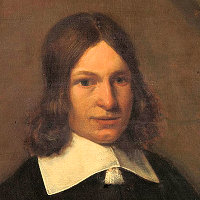 |
Pieter de Hooch, 1629–84. Dutch painter.
His best paintings date from his years in Delft (1655–61), and show scenes of urban life in the sunlit rooms and inner courtyards of Dutch houses, in a manner not too dissimilar from Vermeer. Later in Amsterdam, his quality took second place to quantity. He died in a madhouse.
|
 |
Johannes Vermeer, 1632–75. Dutch painter.
Now considered second only to Rembrandt among the geniuses of the Golden Age, Vermeer did not have much success in his lifetime. Although most of his relatively small body of work could be described as genre subjects (for example, women engaged in household tasks), their sense of greater significance—a simple act suspended in eternity—is not easily explained, though much has to do with the solidity of his forms, his sense of light, and a paint surface that one contemporary described as "crushed pearls melted together."
|
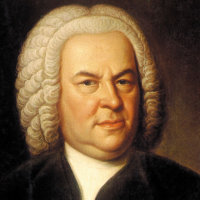 |
Johann Sebastian Bach, 1685–1750. German composer.
The towering genius of German music in the earlier 18th century, Bach was most famous in his time as an organist and choirmaster, most notably at the Thomaskirche in Leipzig. His work includes two Passions, numerous cantatas, and keyboard and orchestral works that codify and extend the possibilities of counterpoint in his time.
|
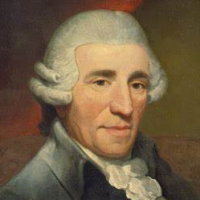 |
Franz Joseph Haydn, 1732–1809. Austrian composer.
With Mozart, Haydn was the leading musical genius of the late 18th century. Equally prolific, but far longer lived, he wrote 104 symphonies, 68 string quartets, 16 operas, and 14 masses, together with the two great oratorios, The Creation and The Seasons.
|
 |
Bernard MacLaverty, 1942– . Northern Irish novelist.
Born in Belfast, Laverty moved to Scotland in 1975 to escape the violence. He is the author of five novels, mainly about faith, love, and identity, His novels Lamb (1980/85), Cal (1983/84), and Midwinter Break (2018/26) were filmed.
|
 |
Peter Webber, 1960– . British director.
Webber has worked in film, television, and documentary. He is probably best known for his first feature film, Girl with a Pearl Earring (2003) based on the Tracy Chevalier novel.
|
 |
Tracy Chevalier, 1962– . American-British novelist.
Born in Wahington DC, the daughter of a Washington Post photographer, Chevalier moved to England after her graduation from Oberlin. She is the author of 11 novels, mostly involving real people in historical contexts. The most famous of these is Girl with a Pearl Earring (1999), which imagines the real life of the young woman depicted in Vermeer's painting of that name.
|
 |
Steve McQueen, 1969– . British director.
Sir Steve Rodney McQueen is a British director of films tackling challenging subjects, such as sex-addiction in Shame (2011), slavery in the Oscar-winning 12 Years a Slave (2013), and the Nazi invasion of Holland in the 4-hour documentary Occupied City (2023),
|
 |
Barbora Horáková, bdnk. Czech director.
Barbora Horáková Joly studied voice in Switzerland and was set on a career as an opera singer before switching to stage direction. Her 2021 staging of Haydn's Missa in Tempore Belli in Amsterdam has led to other invitations (with more standard repertoire) from companies in Germany, Holland, and Geat Britain.
|


