Class 9: Paris: Bridges, Light, and Love.
"The City of Light" / "The City of Love". How did Paris come by these nicknames, and how do they affect the way we
experience the city today? The first, la ville lumière, is what Paris calls itself, and has done so since
the 18th-century Enlightenment at least. You might think that the love moniker arose similarly through the city’s
key role in the Romantic movement in the 19th Century, but it has negative connotations as well, and it is only
fairly recently that Paris has embraced its value as a hook for American visitors. After a brief prologue cruising
down the Seine under its many bridges, we devote one hour of the class to each of these aspects: Light and Love.
rb.
The script, videos, and images will be posted immediately after class.
Q AND A
Is the Champs-Élysées really closed to traffic?
No, I was wrong about that. However, the avenue is closed to traffic on the first Sunday of every month; this practice has now
been extended to several other major boulevards in the city center. In 2021, the Mayor of Paris announced a permanent plan to
reduce the traffic to half its present volume and to add extra tree-lined walkways for pedestrians; this project is expected
to be completed in 2030. According to Wikipedia, though, the avenue has become largely a tourist destination, avoided by
Parisians; a 2019 survey found that 72% of the pedestrians were tourists, 22% worked in the cafés or other businesses, and
only 6% were local residents.
When did Paris clean itself up?
Heidi's sharp eyes picked up on the fact that the Arc de Triomphe in the 1956 Funny Face movie was all blackened. By the
time Woody Allen made Midnight in Paris in 2011, however, this and most of the other buildings were sparkly clean.
Apparently the A-de-T was cleaned by bleaching in 1966 and by power-washing in 2011. I imagine that many other buildings were
similarly cleaned at about the same time, in preparation for the Paris Olympics. The Olympics were also a spur to the cleaning-up
of the Seine, so that you could actually swim in it.
VIDEO LINKS
Most items I showed are available below, generally at greater length. These are all *asterisked. I especially
recommend looking at the two Pomplamousse videos; fun as they are to hear, they are especially delightful to watch!
However, there is a lot else out there, ranging from painstakingly detailed to off-the-wall zany. In the former category, I would
recommend the 32 Bridges, the Place des Victoires video, and those on Diderot and Haussman. The Paris is Out of Control
video might be a salutory corrective to the starry-eyed stuff I mostly showed. At the other extreme, take a look at the weird Céline Dion
clip and A Stroll through Monet's Paris. The latter is an AI product in the style (more or less) of Monet; it really belongs on a
Jacquie Lawson card, but there is quite helpful use of AI in Paris in 37 Minutes and Paris in the 1700s, both of which I
found quite informative. Since preparing this class, I learned that the city is working on reducing vehicular traffic on the Champs-Élysées
(see also my note above); the last clip for the first hour explains a little bit more.
There are fewer added elements for the second hour: a poem-video by Catri Branch that is interestingly quizzical in tone; the classic Marc
Lavoine setting of Le Pont Mirabeau; and a bunch of other movie trailers, most from the 1950s when Hollywood was really pushing Paris
for the American lovers of Romance. I also include a link to the "gerardmenfin" article on Reddit exploring the history of this particular
sales pitch; it has numerous hyperlinks, so use it if you can—but I also include a PDF transcript in case of trouble. rb.
| THE CITY AND THE SEINE |
| |
Overviews |
|
*Paris in 37 Minutes
(AI overview)
*Paris is Out of Control
(the real Paris v. the image)
|
| |
Under the Bridges |
|
*Bateux-Mouches ad
(used under title)
*Know Paris by its Bridges
(used in part)
*Paris Seine cruises
(used in part)
*31 Bridges of Paris
(systematic coverage of all bridges)
*Dinner cruise
(short, romantic)
*Céline Dion
(zany video, shot partly on a bateau-mouche)
|
| |
Music |
|
*Sous les ponts de Paris
(accordeon ensemble, used under title)
*— Edith Piaf original
(audio)
*Sous le ciel de Paris
(Pomplamousse video, used under clip)
*— Edith Piaf original
(audio)
|
| GOTHIC LIGHT |
| |
Buildings |
|
*Cathédrale de Notre Dame
(video visit)
*— stained glass
(issues of restoration)
*— before and after the fire
(15-minute comparison)
*La Sainte-Chapelle
(Rick Steves)
|
| |
Music |
|
*Pérotin: Sederunt principes
(from Notre Dame)
*Pérotin: Beata viscera
(Sarah le Van tribute)
*Sainte-Chapelle concert
(the chapel with old music)
*Eric Whitacre: Sainte-Chapelle
(the chapel with new music)
|
| THE SUN KING |
| |
Buildings |
|
*Paris landmarks built under Louis XIV
(own video)
*Place des Victoires
(detailed treatment of Place Vendôme)
*Paris in the 1700s
(AI reconstruction)
|
| |
Music and Dance |
|
*Gérard Corbiau: Le Roi Danse
(Louis as Apollo)
*— Le bourgeois gentilhomme
|
| |
Te Deum settings |
|
*Lully
(complete)
*Chapentier
(theme of French television)
|
| ENLIGHTENMENT |
| |
Denis Diderot |
|
*The Encyclopédie
(short explanation)
|
| |
Museum of Natural History |
|
*Gallery of Evolution
(similar to the one shown in class)
|
| NINETEENTH CENTURY |
| |
Baron Haussmann |
|
*The Man who Rebuilt Paris
(12-minute documentary)
*How One Man Built Modern Paris
(55-minute documentary)
|
| |
Impressionist Paris |
|
*Camille Pissaro
(all his Paris paintings)
*— Le Boulevard Montmartre
(detailed discussion of single painting)
*Paris Looks Back
(Exhibition introduction, a bit gray)
*A Stroll through Monet's Paris
(AI-generated fantasty)
|
| |
Lumière Brothers |
|
*Loie Fuller's Serpentine Dance
|
| CHAMPS-ÉLYSÉES |
| |
Joe Dassin song |
|
*Aux Champs-Élysées
(Pomplamousse cover)
|
| |
Operation Paris Breathes |
|
*Champs-Élysées without cars
|
| |
| CITY OF LOVE |
| |
Videos |
|
*Make a Date with Paris
*A Romantic Walk in Paris
*YouTube short
(used for section title)
*Paris, City of Love
(poem by Catri Branch)
|
| |
Poetry |
|
*De Musset: Rappelle-toi
(audio reading)
*— with images
(own video)
*Apollinaire: Le Pont Mirabeau
(read by author)
*— female reader
*— setting by Marc Lavoine
(audio only)
*— setting by Louisa Bey
(own video)
|
| |
Other Literature |
|
*Dumas and Marie Duplessis
(from La dame aux camélas film)
*Dreiser on Paris
(Century Magazine, October 1913)
*"Gerardmenfin" article
(Reddit/AskHistorians, 2024)
*— transcript of the above
|
| |
Films and Television |
|
*American in Paris
(trailer 1951)
*Moulin Rouge, can-can
(1952)
*The Last Time I Saw Paris
(trailer 1954)
*Funny Face, "Bonjour, Paris!"
(1957)
*Gigi
(trailer 1958)
*Midnight in Paris, opening
(Woody Allen, Sidney Bechet, 2011)
*Emily in Paris
(trailer 2020)
|
| |
|
|
|
|
|
| IMAGES |
The thumbnails below cover the slides shown in class, plus the
individual images in some of the montages. Click the thumbnail to see a larger image.
Click on the right
or left of the larger picture to go forward or back, or outside it to close. |
 | |
 | |
 | |
 | |
 | |
 | |
 | |
 | |
 | |
 | |
 | |
 | |
 | |
 | |
 | |
 | |
 | |
 | |
 | |
 | |
 | |
 | |
 | |
 | |
 | |
 | |
 | |
 | |
 | |
 | |
 | |
 | |
 | |
 | |
 | |
 | |
Here are brief bios of the composers and writers considered in the class, listed in order of birth. Note that the
list does not include some people who I suspect will not come up in other classes.
 |
Pérotin, 1160–1240. French composer.
Wikipedia writes: "Pérotin, about whom little is known, most likely lived around the end of the 12th and beginning of the 13th century and is presumed to have been French." He was an important figure in the Notre Dame School of polyphony, introducing writing for several parts.
|
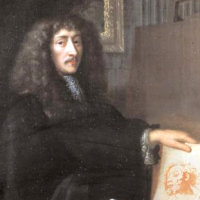 |
Jean Nocret, 1615–72. French painter.
Nocret is known today for his royal portraits in the age of Louis XIV, especially his group showing the extended royal family in the guise of Greek gods.
|
 |
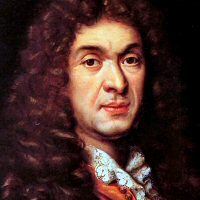
Jean-Baptiste Poquelin (Molière), 1622–73. French playwright.
Molière might be set beside Racine as the comic and tragic masks respectively of French classical theatre. A working actor himself (he died acting in one of his own plays), he had a practical sense of what worked with an audience, including devices taken from popular comedy. But his willingness (like Shakespeare's) to occasionally write farce should not detract from his control of the French language, which was as great as Racine's.
|
 |
Jean Baptiste Lully, 1632–87. French composer of Italian origin.
Lully became master of music to Louis XIV, writing music in all genres, but most especially operas and ballets. His operas include Alceste (1675), Atys (1676), Persée (1682), and Armide (1686). For most of his career, no new music could be performed in France without his approval.
|
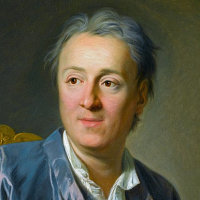 |
Denis Diderot, 1713–84. French philosopher, writer, and critic.
One of the key figures of the Age of Reason, his chief fame is as co-founder (with d'Alembert) and editor of the Encyclopédie, which brought together scientific knowledge and Enlightenment thought.
|
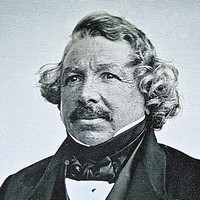 |
Louis Daguerre, 1787–1851. French photographer and designer.
Working originally with Nicéphore Niépce, Daguerre perfected the daguerrotype process of photography. It was hailed as a revolution. The French government purchased the rights in exchange for a lifetime pension, and then published the methods as "France's gift to the world." Daguerre was also an accomplished designer and scene-painter.
|
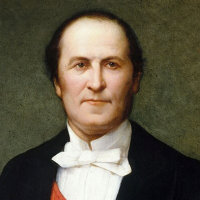 |
Georges-Eugène Haussmann, 1809–91. French city planner.
Baron Haussmann—as he was known, though the title is an honorary one—was appointed Prefect of the Seine by Napoleon III in 1853 and became responsible for the extensive city planning that implemented the Emperor's dream of an open and beatiful Paris. He did this by creating the large parks to the east and west, knocking down slums, and building wide open boulevards linking major landmarks, many of which (such as the Opéra) he instigated himself. Of course it was impossible to do so much without making enemies, and he was forced out of office in 1870.
|
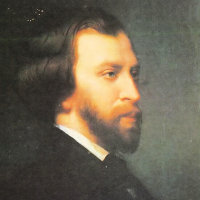 |
Alfred de Musset, 1810–57. French writer.
A Romantic poet and dramatist, he is best known for his turbulent 1833–35 love affair with George Sand recounted in his autobiographical 1836 novel Confession of a Child of the Century, extensive correspendence, and numerous poems. Sand also published her own version of the affair.
|
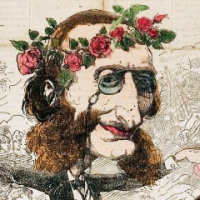 |
Jacques Offenbach, 1819–80. German-French composer.
The son of a cantor, Offenbach took the name of the German town near Cologne in which he was born. After studying briefly at the Paris Conservatoire and establishing a career as cello soloist and conductor, he began to write operettas, composing over 90 in the course of a long and wildly successful career. He is also known for his unfinished grand opera The Tales of Hoffmann.
|
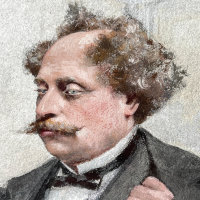 |
Alexandre Dumas, fils, 1824–95. French writer.
Dumas fils was the natural son of the elder Alexandre Dumas, author of The Three Musketeers and The Count of Monte Cristo. The son's principal claim to fame is as author of the semi-autobiographical novel La dame au camélias (1848), later made into the play that became the source for Verdi's La traviata. Although he was born out of wedlock, his father recognized him and ensured that he received an excellent education.
|
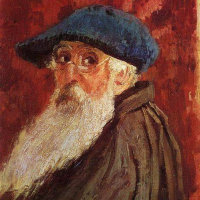 |
Camille Pissarro, 1830–1903. French painter.
Born in the West Indes, where his father was a successful planter, he did not settle in Paris until 1855. Shortly thereafter, he met Monet, and with him became a central figure of Impressionism. He was the only artist to take part in all eight exhibitions, and the only one not to diverge into a distinctly different style.
|
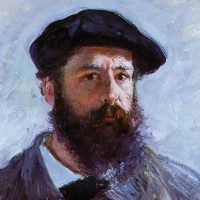 |
Claude Monet, 1840–1926. French painter.
The central figure in Impressionism (it was his Impression: Sunrise of 1872 that gave the movement its name), he intensified its focus more than any other artist, continuing well into the next century to produce series of paintings showing minute variations in the light and color in basically the same scene. Cézanne famously said of him, "Monet is nothing but an eye—but my God, what an eye!"
|
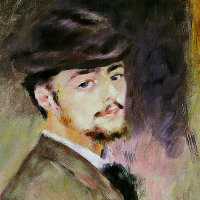 |
Pierre-Auguste Renoir, 1841–1919. French painter.
A leading member of the Impressionist group, he began his career as a china painter in the Limoges factory, which—together with his admiration of Rococo masters such as Watteau and Fragonard—may have influenced the sweetness of color seen in much of his work. He was more concerned with detail, and more interested in figures than most of his colleagues.
|
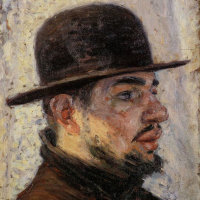 |
Henri de Toulouse-Lautrec, 1846–1901. French painter.
A hunting accident in childhood (he came from an aristocratic family) left Toulouse-Lautrec permanently stunted in stature, but this condition gave him both an entrée into the seamier side of Paris and the realism to depict it as he found it, with plenty of glamor certainly, but without idealization or moralizing.
|
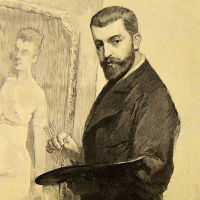 |
Henri Gervex, 1852–1929. French painter.
Gervex began in an academic vein, but later devoted himself to depictions of modern Parisian life. Although many of his works show fishionable society, he could also paint workmen and the bourgeoisie.
|
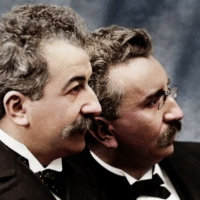 |
Auguste Lumière, 1862–1954. French cinematographer.
Auguste (left) and his brother Louis (1864–1948) were early manufacturers of photographic equipment. They are generally credited with developing the first film camera and making the first short films. But they saw film as more a novelty than the major narrative medium it became, and withdrew from film-making in 1905. Among their later inventions, however, was the development of the first practical color process.
|
 |
William Glackens, 1870–1938. American painter.
Beginning as a newspaper illustrator, Henri was encouraged by Robert Henri to take up painting, and became a central figure in the Ashcan School and in 1913 an organizer of the Armory Show. His subject matter was realist, but in style he was much influenced by French Impressionists such as Renoir.
|
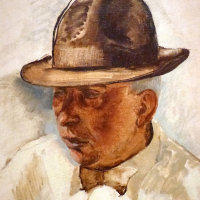 |
Theodore Dreiser, 1871–1945. American writer.
Dreiser was a journalist and realist novelist best known for Sister Carrie (1900) and An American Tragedy (1925). His novels feature characters who abandon traditional moral codes; they themselves may succeed, but they leave tragedy in their wake.
|
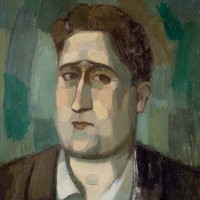 |
Guillaume Apollinaire, 1880–1918. Polish-French poet.
Guillaume Apollinaire, as he called himself in France (his birth name was Wilhelm Albert Wlodzimierz Apolinary Kostrowicki), was a pioneering modernist poet and art critic. His major poetry collections were Alcools (1913) and Calligrammes, published after his death from shrapnel wounds in 1918. He is credited with nventing the art terms Cubism, Orphism, and Surrealism, and his poetry strives for similar effects. The portait is by Jean Metzinger.
|
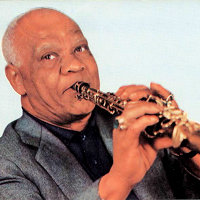 |
Sidney Bechet, 1897–1959. American saxophonist.
Bechet, who never learned to read music, grew up in New Orleans, playing with the city's many bands. He started as a clarinettist, but switched as an adult to the soprano saxophone, establishing it as a significant jazz instrument. He started making solo recordings in the 1920s, slightly ahead of Louis Armstrong and Duke Elington, both of whom acknowledged his influence. He spent most his later life in France.
|
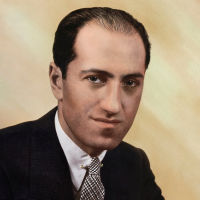 |
George Gershwin, 1898–1937. American composer.
Born Jacob Gershwine in New York to Jewish emigrants from Eastern Europe, he studied piano and composition, but soon found his vocation as a songwriter, mostly with his elder brother Ira (born 1896). Most of his songs have become crossover standards, as have his orchestral works Rhapsody in Blue (1924) and An American in Paris (1928). Most of his stage works are primarily containers for his songs, but his 1935 opera Porgy and Bess is an exception, a closely-developed study of African-American life.
|
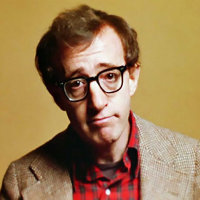 |
Woody Allen, 1935– . American writer and filmmaker.
Allen (born Allan Stewart Konigsberg) began wrting comic material for other comedians, then developed his own show and published under his own name. Beginning in 1969, he directed a string of madcap comedy films with himsself in the lead, but starting with Annie Hall in 1977, these have become more romantic and/or serious. He has continued to direct (now mostly with other actors), and holds a record for the most Oscar nominations (16), including many outright wins of this and other major awards.
|
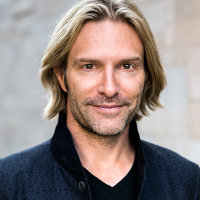 |
Eric Whitacre, 1970– . American composer.
After playing in a techno-rock band in his teens, Whitacre discovered choral music while a student at the University of Nevada, thus setting his future career as a composer and conductor of both choral and orchestral music. He has written for major orchestras and performing groups around the world, and also in Hollywood, first as an assistant to Hans Zimmer and later on his own.
|


