Class 10: London, City of the Times.
Only while preparing this class did I realize how important London was to my sense of identity. I grew up in Ireland, but as the son of an
English father, I was always viewed as foreign, a little bit strange. But my aunt's house in Chelsea was my home from home when I couldn't
get back. She organized my first trips to orchestral concerts and the ballet; we saw exhibitions at the Royal Academy and visited the South
Kensington museums; we shopped in the West End, took walks in the Royal Parks. Looking back now, I see London as a Victorian city that grew
up to reflect the needs and preoccupations of a newly-prosperous middle class. Though it may sound snobbish to say so, it was the city that
first gave me a sense of where I belonged.
So this will probably be a more personal class than most. After taking a rapid overview of the millennium of history that still leaves traces
on London, we shall concentrate especially on the city in what we may call the Long Nineteenth Century (around 1780 to 1914). The first hour
has three topics: Empire, Technology, and the River Thames. While all three were important forces on Victorian London, they do pose problems
in the modern era. Colonialism is a dirty word, and most traces of Empire have been erased. Technology has become the currency of modern life
everywhere, and the pioneering contributions in Great Britain are now taken for granted. And the great era of the London Docks, which made
Victorian London the most prosperous city in the world, has come and gone.
In the second hour, we look especially at the provision of amenities for the rising middle-classes. The cluster of museums and other
institutions that sprang up after the Great Exhibition, as a continuation of Prince Albert's belief in education, science, and the
arts. The growth of the London parks. The big stores and specialist shops that made the West End a magnet for all who could afford it.
And the success of the London theatre, in particular the works of Gilbert and Sullivan presented at the new Savoy. rb.
The script, videos, and images will be posted immediately after class.
Here are brief bios of the composers and writers considered in the class, listed in order of birth.
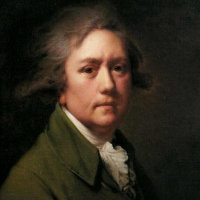 |
Joseph Wright of Derby, 1734–97. English painter.
A highly original painter, and important precursor of Romanticism, he adapted the candlelight and moonlight genres of Dutch painting to English landscape subjects and scenes relating to the Industrial Revolution.
|
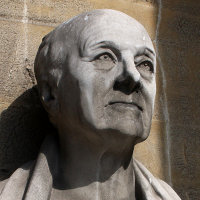 |
John Nash, 1752–1835. English architect.
The leading architect of the Georgian and Regency periods, Nash was largely responsible for establishing the classical face of London, with Regent Street, the Regent's Park terraces, Buckingham Palace, and Marble Arch. He also designed several buildings in non-classical picturesque styles, most notably the Indian-inspired Royal Pavilion at Brighton.
|
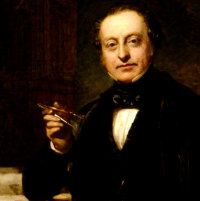 |
Charles Barry, 1795–1860. English architect.
Barry's first commissions as an architect were for churches in the Gothic style, but his later buildings mostly used the classical style of the Italian palazzo as the basis for city buildings and country houses. The two styles met in his designs for the Houses of Parliament which, as his collaborator Augustus Pugin remarked, put "Tudor details on a classic body."
|
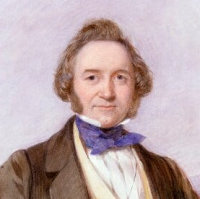 |
Joseph Paxton, 1803–69. English architect and gardener.
Paxton faked his age as a teenager to obtain employment as an under-gardener at Kew. His energy impressed the Duke of Devonshire, who made him his head gardener at Chatsworth at the age of 20. There, among other things, he developed the cultivar of banana most commonly eatern today, and built a revolutionary greenhouse to house it. Such experiences put him in a position to propose a giant glasshouse for the Great Exhibition in 1851—the Crystal Palace—which in turn catapulted him to a career in more conventional architecture.
|
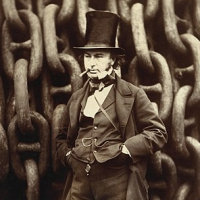 |
Isambard Kingdom Brunel, 1806–59. English engineer.
Brunel is credited with altering the face of England more than any other engineer of the Industrial Revolution, creating railroads, tunnels, bridges, stations, and the first transatlantic steamer. Among his most notable works are the Clifton Suspension Bridge and Paddington Station.
|
 |
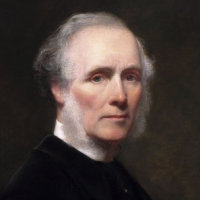
William Schwenk Gilbert, 1813–1911. English playwright.
The author of many straight plays as well, Gilbert gained lasting fame as the librettist and theatrical genius behind the 14 operettas ("Savoy Operas") written with Arthur Sullivan between 1871 and 1896. These became almost as popular in America as the were in Britain.
|
 |
William Powell Frith, 1819–1909. English painter.
Frith began his career as a portrait painter (his subjects including Charles Dickens), but branched out to literary and genre subjects and the vast panoramas of contemporary life such as Derby Day and Railway Station that became his best-known legacy.
|
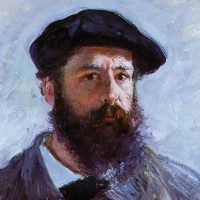 |
Claude Monet, 1840–1926. French painter.
The central figure in Impressionism (it was his Impression: Sunrise of 1872 that gave the movement its name), he intensified its focus more than any other artist, continuing well into the next century to produce series of paintings showing minute variations in the light and color in basically the same scene. Cézanne famously said of him, "Monet is nothing but an eye—but my God, what an eye!"
|
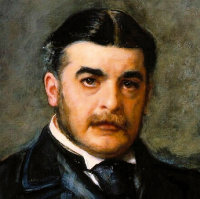 |
Arthur Seymour Sullivan, 1842–1900. English composer.
Sullivan essentially had two careers: as a classical composer of orchestra music and oratorios on suitably uplifting subjects, and as the musical partner to W. S. Gilbert on the highly successful series of Savoy Operas from HMS Pinafore (1878) to The Gondoliers (1889) and beyond. History only remembers him in the latter role.
|
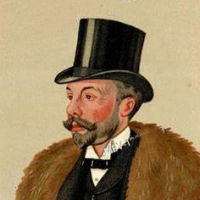 |
Richard D’Oyly Carte, 1844–1901. English impresario.
Originally a singer and conductor, D'Oyly Carte found great success later by commissioning the 14 "Savoy Operas" from Gilbert and Sullivan, building a theatre to perform them in (plus an hotel), and controlling their subsequent distribution through stringent copyright. His posthumous grip on their performance did not end until 1961. His foundation of the Royal English Opera was markedly less successful.
|
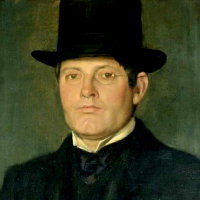 |
Edward Reginald Frampton, 1850–1923. English painter.
Frampton was a British painter who specialized in murals, mainly of religious subjects for churches. He was influenced both by the Pre-Raphaelites and by the handling of similar subjects by Puvis de Chavannes.
|
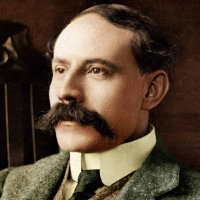 |
Edward Elgar, 1857–1934. English composer.
Elgar was the leading figure in English music during the late Victorian and Edwardian eras. With works such as the Enigma Variations and his concerti for violin and cello, he was one of the first English composers after Purcell to achieve an international reputation.
|
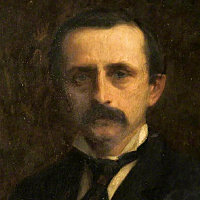 |
J. M. Barrie, 1860–1937. Scottish writer.
Raised and educated in Scotland, James Matthew Barrie came to London and published numerous novels and stage plays, of which by far the most famous is Peter Pan (1904)—a development of a character he had introduced in an earlier book. He donated all the royalties from his Peter Pan works to the Great Ormond Street Children's Hospital. He was made a baronet in 1913.
|
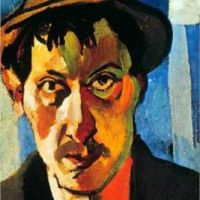 |
André Derain, 1880–1954. French painter.
Derain originally studied to be an engineer, but Matisse convinced his parents to allow him to paint full-time. He joined with Matisse in creating the Fauve movement in 1905, characterized by the use of strong colors that were not necessarily those seen in nature. After about 1910, however, he became more conservative in both brushwork and palette.
|
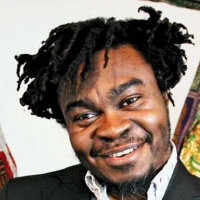 |
Yinka Shonibare, 1962– . Nigerian-British artist.
Born in London to Nigerian parents, Shonibare went back to Africa with them as a child, before returning to England in his late teens. He is famous for his use of highly colored African fabrics for his sculptures and assemblages, that frequent explore themes of colonialism and subjugation. Paralyzed on one side of his body through illness, he uses assistants to complete the work that he designs.
|


