4. Extravagance Eschewed.
Carmen and La bohème are two of the most colorful operas in the repertoire. So what would persuade a director
to stage either of them in near-monochrome and with virtually no scenery? Yet both the Catalan director Calixto Bieito
with Carmen and the Australian Barrie Kosky with La bohème (inset) have devised minimalist
productions that have been seen all over the world. Neither director is especially known for restraint in his other work (and
that's an understatement!), so what did each think could be gained by removing the Paris street scenes of the one or the Seville
flamenco of the other?
The term "realism" in opera production has two almost opposite meanings. On the one hand, the meticulous re-creations of the
late Franco Zeffirelli, who crammed the stage with extras wearing costumes true to period in every last detail, even down to
the corsets of the women. On the other hand, updated productions that eliminate pictorialism in favor of showing the characters
as real people doing real jobs in real surroundings. Such an approach is not suitable for all operas, but for those whose
box-office success has depended so largely on spectacle, the denial of extravagance may well be a revelation.
The handout above contains a fairly detailed plot synopsis of Carmen, but you can also get a funny five-minute video summary
here. I did not have room to do a similar summary for La bohème, but
there is a just slightly more sober one from London's Royal Opera House here.
The script, videos, and images will be posted immediately after class. rb.
VIDEO LINKS
Mixed results for Kosky's Bohème, I'm afraid. All the supporting clips are available, plus much else, but thee are no extended
sequences of his production in Berlin. However, we do have an excellent spoken introduction (in English) by Kosky himself, a short trailer,
a longer trailer clip with substantial parts of the arias by Rodolfo, Musetta, and Mimì, the latter overlapping the scene we saw in class.
We also have a substantial rehearsal video including performance clips and interviews. I append trailers of three other Kosky productions:
a Carmen in London which he treats with Broadway pizzazz, and two other Puccini operas—Tosca and Turandot—even more
completely re-imagined than his Bohème. Finally, I attach a trailer and two musical numbers from a Bohème production at
Glyndebourne by Floris Visser, showing that Kosky did not have the monopoly on rendering this opera in monochrome; you will notice that
the young lovers are literally stalked by death.
For Bieito's Carmen, we have a similar story. The good news is that there are at least two complete versions of the production out
there, both from Italy. The bad news is that the only way to get this with titles in English is to buy the DVD for about $25. There are
shorter clips, however, of what I consider the reference versions of this production (Barcelona and Paris) and the English-language version
at the English National Opera. For the sake of contrast, I attach links to the complete Zeffirelli spectacular from Verona, an updated
production from Lithuania (very colorful and with major international stars), and a montage of recent shots of the opera from all around
Europe.
I would especially call your attention to the bunch of trailers from other Bieito productions, although none of them are what you
might call realistic. His Monteverdi Coronation of Poppea in Zurich is as lush as his Carmen was sparse, and really has me
wishing I could have seen the whole thing. The Janacek From the House of the Dead is another prison opera; I might have included it
last week, but didn't; for a subject that normally demands a grinding realism, it is interesting to see how Bieito went in the opposite
direction, with a staging crammed with symbolism and color. And his Così fan tutte in Nuremberg is not the familiar opera, but
an examination of what might have happened to the two couples after the curtain had fallen, using a new text and a reshuffling of
Mozart's music; again, I would go a long way to see it.
*Asterisks indicate the few clips that were seen in class. rb.
| BARRIE KOSKY |
| |
La bohème in Berlin |
|
* director's introduction
* 1-minute trailer
* 4½-minute trailer with arias
* rehearsal footage
|
| |
Other Kosky productions |
|
* Monteverdi: Orfeo aria
* Wagner: Die Meistersinger opening
(complete, cued to start in class)
* — end of Act I
(as above)
* — trailer
(4½ minutes)
* Bizet: Carmen trailer
(London, very short)
* Puccini: Tosca trailer
(Amsterdam)
* Puccini: Turandot trailer
(Amsterdam, with commentary)
|
| |
La bohème at Glyndebourne |
|
* trailer
(Floris Visser, director)
* duet at end of Act I
* Musettta's aria
|
| CALIXTO BIEITO |
| |
Carmen, Barcelona |
|
* buy DVD
(Amazon, about $25)
* trailer
* ending
(Alagna, Uria-Monzón)
|
| |
Carmen, Paris |
|
* complete
(includes intermission)
* final scene
(French titles)
* trailer
(in English)
|
| |
Carmen, ENO in English |
|
* short trailer
* Habañera
(Justina Gringyté)
* Acts 3 and 4
(first half not avilable)
|
| |
Carmen, elsewhere |
|
* Palermo all
(no titles)
* Venice, acts 1 and 2
(no titles)
* Venice, acts 3 and 4
(no titles)
|
| |
Non-Bieto Carmens |
|
* Verona 2022
(Zeffirelli, cued to Act II)
* Riga 2007
(updated, international cast)
* montage of stills 2017
(various European cities)
|
| |
Other Bieito productions |
|
* Monteverdi: L'incoronazione di Poppea
(Zurich)
* Janacek: From the House of the Dead
(Nuremberg)
* Mozart: Così fan tutte
(Basel, see above)
|
| |
|
|
|
|
|
| IMAGES |
The thumbnails below cover the slides shown in class, though
there may be a few small discrepancies.
Click the thumbnail to see a larger image.
Click on the right
or left of the larger picture to go forward or back, or outside it to close. |
 | |
 | |
 | |
 | |
 | |
 | |
 | |
 | |
 | |
Here are brief bios of the composers and directors considered in the class, listed in order of birth.
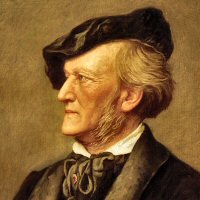 |
Richard Wagner, 1813–83. German opera composer.
Wagner almost single-handedly transformed the nature not only of opera but also of harmony and orchestration. His 10 mature operas include Tristan und Isolde (1865), Die Meistersinger von Nürnberg (1868), and the vast tetralogy Der Ring des Nibelungen (completed 1876), for which he had a special theater built at Bayreuth. His final opera, Parsifal (1882), was written for exclusive performance at that theater.
|
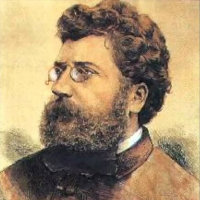 |
Georges Bizet, 1838–75. French composer.
Bizet's teenage Symphony in C (1855) remains a concert staple, and his winning of the pestigious Prix de Rome in 1857 promised a brilliant future. And indeed he wrote a string of works, mainly for the stage, that ensured his continued popularity, though only his music for Arlésienne and his opera The Pearl Fishers are frequently performed. That is until his final work, Carmen, one of the most popular operas of all time. Ironically, though, he died a few weeks of its premiere in 1875, believing that it had been an abject failure.
|
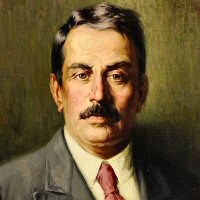 |
Giacomo Puccini, 1858–1924. Italian composer.
Puccini took up the mantle of Verdi as the dominant opera composer of the late 19th century, and developed an international popularity that is unrivaled to this day. His principal works include: Manon Lescaut (1893), La bohème (1896), Tosca (1900), Madama Butterfly (1904), and the unfinished Turandot (1926).
|
 |
Franco Zeffirelli, 1923–2019. Italian director.
As director and designer of classic theatre and opera, Zeffirelli set a standard of lavish period realism in which no detail was too small. His many productions at the Met were greatly beloved and have proved difficult or impossible to replace. He carried a similar aesthetic into his films of Shakespeare and opera from the '60s to '90s. He was also a consummate director of actors, whether established stars or often young performers. He served in the Italian Senate 1994–2001.
|
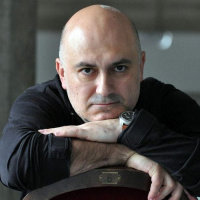 |
Calixto Bieito, 1963– . Spanish-Catalan opera director.
Though born in central Spain, Bieito moved with his family to Barcelona in 1977, and he has long identified himself as Catalan. He is known for his provocative modernized productions of classic operas, emphasizing sex and violence which have raised controversy all over Europe. Over time, though, his views have found wider acceptance, and he now finds himself with something like grand-old-man status. His Carmen, first staged in 1999, has been seen all over Europe and is now regarded as a classic. He directed a full cycle of Wagner's Ring in Paris in 2025–26.
|
 |
Barrie Kosky, 1967– . Australian opera director.
Kosky, who describes himself as a "gay Jewish kangaroo" is one of the leading directors on the Euopean opera stage. His 2017 production of Die Meistersinger at Bayreuth was the first by a director not called Wagner, and the first to address the composer's anti-Semitism head-on. Beginning as a director of both opera and theater in Australia, he came to Europe in 2000, and has held important posts in Vienna, Munich, and Berlin, where he was Intendant of the Komische Oper 2012–22. An accomplished pianist, he is equally at home in cabaret, musical theater, and operetta.
|


